When a resident gives you a gift: can you accept it?
A real r/cna question about a long-term resident who keeps offering cash, gift cards, and homemade food. The ethics, the facility policy angle, and what to actually say when refusing feels cruel.
A CNA on r/cna posted this:
I have a resident who I've been caring for almost daily for two years. She's elderly, sharp mentally, and absolutely loves me. Last week she slipped me a $50 bill folded in a thank-you card. I told her I couldn't take it but she just smiled and said "don't tell anyone." This is the third time in the past year. The previous two were small gift cards. I refused both. She cried and said I was being cold. My charge nurse says just take it so I don't upset her. My DON says I can't accept anything over $5. I genuinely don't know what to do.
This comes up constantly in long-term care. It feels like a small thing, but it's one of the few situations where the "right" answer and the kind answer can pull in opposite directions. Here's how to think through it.
Why this is genuinely complicated
Most CNA training covers the rule — gifts are discouraged, some facilities ban them entirely — but doesn't cover what it feels like to refuse a $20 from a resident who reminds you of your grandma. The ethical framework is straightforward. The actual moment isn't.
Three things are in tension at the same time:
The resident's autonomy. A mentally sharp resident has the right to do what they want with their own money. They are not a patient in a hospital — they live here. Refusing their gesture can feel like you're treating them as someone without agency.
The caregiver relationship. Accepting a gift can quietly shift the dynamic. It creates a sense of obligation, on either side. It can also single you out as "the favorite" in ways that complicate things with your coworkers.
The facility's standing. Most facilities have a written gift policy because they have to. Surveyors look at it. Abuse-prevention frameworks flag gifts as one possible vector for financial exploitation concerns, even when the resident is the giver. Your facility's policy isn't bureaucracy — it's the documented answer to a question surveyors ask every year.
What the rule actually says
Across most states and most facilities, the framework is:
- Homemade food, baked goods, small tokens (a card, a craft): usually fine. The emotional value matters more than the dollar value, and refusing a crocheted scarf from a 90-year-old is more harmful than accepting it.
- Cash or cash equivalents (gift cards, prepaid cards, checks): generally not allowed, or capped at a small amount (often $5-$20 depending on the facility).
- Anything that looks like a pattern, especially if the resident has cognitive impairment: flag to the nurse regardless of value.
The reason cash is treated differently isn't about being ungrateful. It's because cash creates a documented exchange that can be misinterpreted later — by the family, by the state, by a new administrator who doesn't know you.
What to actually do in the moment
The textbook answer is "decline politely and report to the nurse." The real answer is more textured:
Step 1: Don't take the gift in the moment, but don't take it back either. If the resident hands you something and you're caught off-guard, say something warm that acknowledges the gesture without accepting. "That is so sweet of you to think of me. I'm not allowed to take gifts at work — but I'd love to hear about [the thing they wanted to share with you, like a family photo or a story]."
The point is to redirect the warmth of the gesture to the relationship, not the object. Most residents aren't actually trying to give you money — they're trying to tell you that you matter.
Step 2: Tell your charge nurse within the shift. Not because the resident is doing anything wrong, but because the pattern matters. If the resident is doing this with three different CNAs, that's information the care team needs. If they're only doing it with you, that's also information.
Step 3: Document it in your own way. You don't need to write an incident report for a $20 gift card. But a note in your shift documentation — "Resident attempted to give CNA a $20 gift card, declined per facility policy, redirected to conversation" — covers you if it ever comes up later.
Step 4: If the resident persists, escalate to the nurse manager or social worker. Some residents have cognitive changes that aren't visible to staff. A resident who is repeatedly trying to give away significant money can be an early signal of a financial-decision-making change that the family and care team should know about. This isn't betrayal — it's part of the safety net.
What NOT to do
This is where most CNAs get tripped up:
Don't take it "this once" and say nothing. The most common path to a real problem is a small gift accepted with good intentions that nobody documented, followed by a larger one, followed by a misunderstanding with the family six months later. Once you've accepted a gift off the books, you're in an ambiguous position forever.
Don't accept because the resident will be upset. The hard part of this work is that residents sometimes cry. A resident in long-term care has likely had a lot of practice being told "no thank you" by people who love them — family, doctors, even themselves. Your boundary doesn't have to be a rejection. It just has to be clear.
Don't accept because your charge nurse told you to. If your charge nurse is telling you to take it, they may not understand the facility's policy, or they may be conflating their personal preference with the institution's actual rule. Check the actual written policy. The DON, the administrator, and the state surveyor are the ones who define the policy. Your charge nurse's opinion is just an opinion.
Don't tell the resident they're "not allowed." This makes the resident feel like a child. The right framing is "I am not allowed", not "You are not allowed." The first respects them. The second doesn't.
Don't accept on behalf of the unit ("I'll share it with everyone"). This is a common workaround. It usually doesn't satisfy the resident (they wanted to give YOU something), it can still violate policy, and it puts you in the position of deciding what to do with the resident's money.
What about the gifts you're allowed to keep
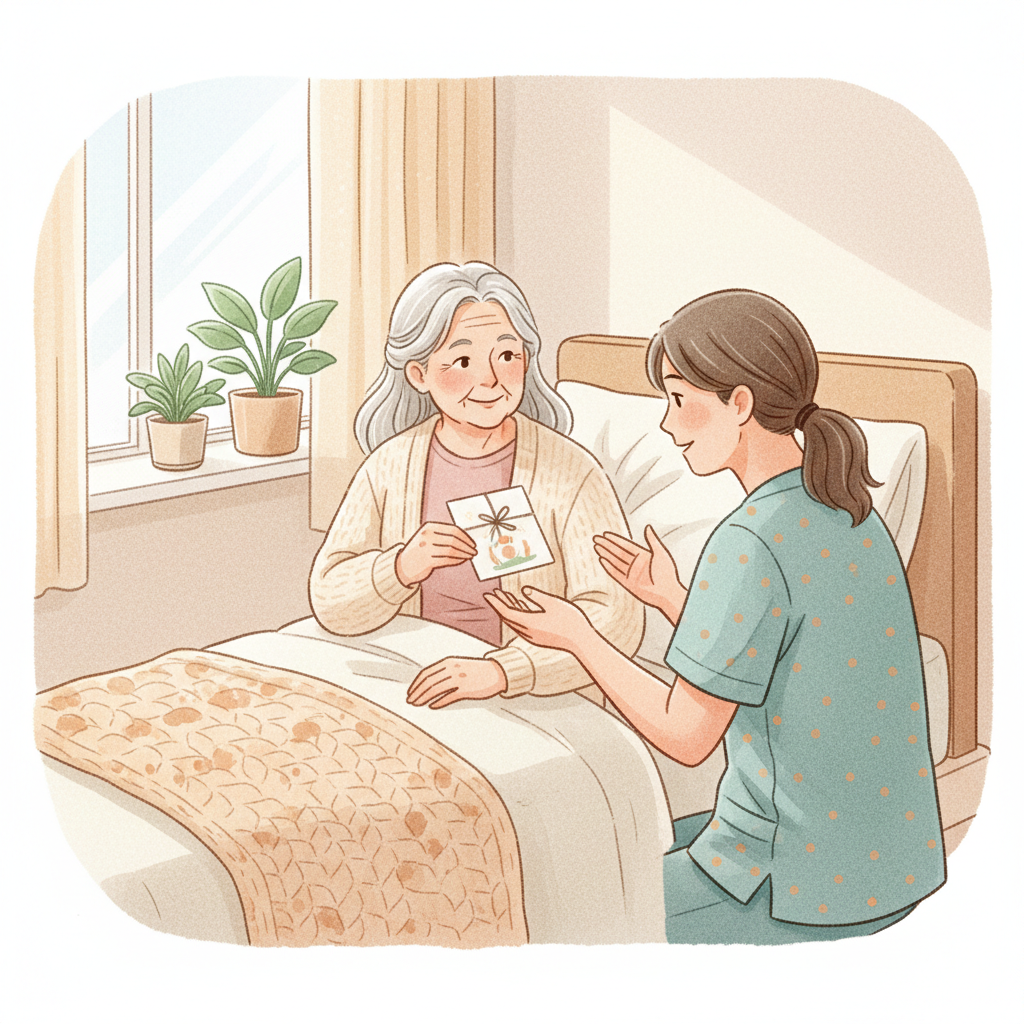
The crocheted blanket. The handmade card. The tin of cookies. The photo from the resident's 70th wedding anniversary with a note on the back that says "thank you for keeping me company."
Take these. Accept them warmly. Thank the resident by name. These are the gifts that the policy is designed to leave room for, and they're the gifts that actually mean what they look like.
If you want to honor the resident back, you can write a short note of your own. "Thank you for the cookies — I shared them with my partner and they were the best part of my day." That kind of acknowledgment is appropriate, healthy, and well within scope.
The cash gift is almost never about the cash. It's about the resident feeling that you see them as a person, not a task. You don't need the cash to give them that. A consistent, warm, present relationship does it better than any $50 bill.
If this kind of post is useful, the full ExamReady library has 1,500+ practice questions, clinical skills with critical-step tracking, and an AI tutor that explains every answer — the same scope-and-voice approach as these posts, with the actual exam tools attached. A 7-day free trial gets you the whole thing, no card required.