Resident keeps asking when family is visiting: how to answer honestly without making it worse
A real r/cna-style scenario about a long-term care resident who asks every hour when their daughter is coming, gets upset when she doesn't show, and the CNA is left absorbing the grief. What's actually going on and what to do.
A CNA on r/cna posted this:
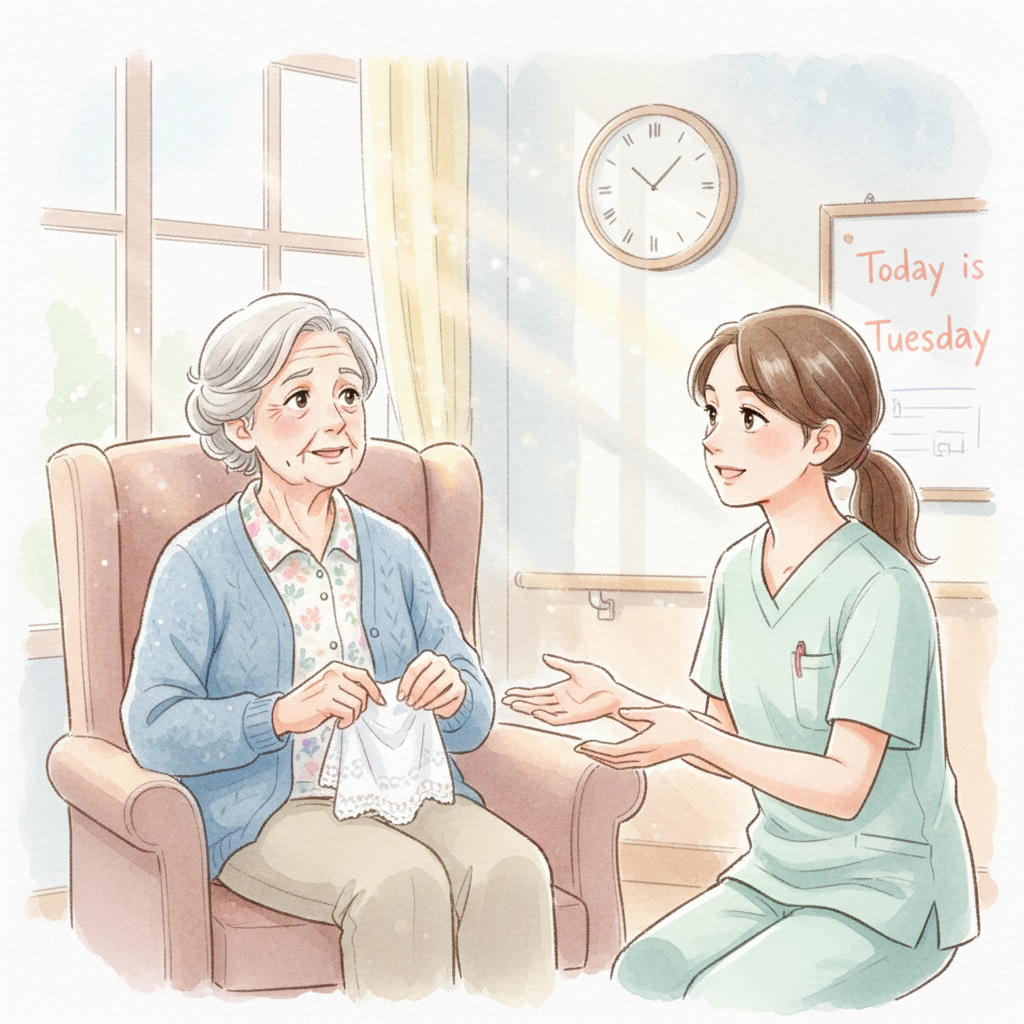
I have a resident on my hall, sweet older lady, totally with it cognitively, just lonely as hell. She asks me every single time I walk past her room, "When is my daughter coming? She said she'd be here today." I've told her three times today that I don't know, that I can't call her daughter, that visiting hours are 8 to 8. She still asks. And when her daughter doesn't show up by dinner, she cries. Not loud, just quiet tears while she picks at her tray. I don't know what to say anymore. I don't want to lie to her. I don't want to make it worse. I just want to make her feel less alone without making promises I can't keep.
This post got 312 upvotes and a lot of "same" replies. It's one of the most common emotional situations in long-term care, and almost nobody trains you for it.
Why this happens
Residents who repeatedly ask about a family member are not confused, even when it looks that way from the outside. They are doing one or more of these things:
Tracking time without a clock. A long-term care room has very few ways to tell what time it is, and almost no way to know what day of the week. Asking when someone is coming is how the resident measures whether the day is going the way they thought it would.
Checking that you are a real person who will answer. In a facility where staff rotate every shift, every resident learns quickly that the friendly CNA from yesterday isn't here today. Asking the same question ten times is partly a test: are you still going to respond to me?
Processing real grief. A daughter who said "I'll be there Tuesday" and didn't show is a small bereavement every time it happens. The resident is rehearsing the loss out loud, hoping you'll help her make it make sense.
Loneliness, plain. Some residents see family once a month. Some see family once a year. The question isn't really about the visit — it's about being remembered.
The mistake is to treat the question literally. "I don't know" is technically true but emotionally useless. "She'll be here soon" is kind but a lie she'll remember when 6 p.m. comes and goes.
What usually doesn't work
The default answers CNAs give in this situation fall into three traps:
The dismissive brush-off. "I'm sure she's coming, don't worry about it." Said to a person with intact cognition, this reads as fake. They know you're brushing them off. They feel patronized.
The promise. "I'll go call her right now." You can't do this. It's outside your scope. And when you don't actually call — or when you do call and the daughter doesn't answer — the resident has been promised a result and is now waiting on you.
The deflection. "Let me go check your chart." Or "I'll ask the nurse." Both are stalls that buy you about thirty seconds before the question comes back. The resident knows you weren't actually going to do anything, because if you were, you'd have done it the first three times.
What tends to work
1. Answer the question behind the question.
Most of the time, "when is my daughter coming?" really means "I miss her and I feel forgotten." You can't fix the missing. You can acknowledge it.
Try: "I hear you. Waiting is the hardest part of being here, isn't it." Or: "You really miss her. I can see that." Then pause. Don't rush to fix it. The pause itself is the medicine.
Responding to the feeling instead of the question takes maybe fifteen seconds and reduces the next ask by a lot, because the resident has been seen.
2. Give the truth in a form she can hold.
"I'm not sure when she's coming today. If she does come, she'll have to check in at the front desk, and I'll see her walk down the hall. I'll let you know the moment I see her." That's not lying. That's not promising. It's giving her something concrete to anchor to: the front desk, the hallway, your eyes on the door.
If the resident's family has told the nurse a specific window — "between 2 and 4" — share that. If the family has been vague or non-committal, say so: "She hasn't given us a specific time today, but visiting hours go until 8." That's the truth.
3. Make the waiting smaller.
A whole afternoon of "I wonder when she's coming" is unmanageable. Break it up.
"Are you up for a walk to the activity room after lunch? Mrs. J is doing a crossword and she'd love the company." You are not pretending to be the daughter. You are giving her a 45-minute block where the question doesn't own her.
This works best when you know the resident's actual interests — what she read, what she watched, who she used to work with. A generic "come out to the activity room" lands flat. A specific "Mrs. J wants help with the crossword" lands.
4. Document the pattern.
If the asking is happening every shift, every day, write it down in your shift notes: Resident repeatedly asked about daughter today, became tearful at dinner when daughter did not arrive, redirected with walk to activity room. This is not busywork. It tells the care team that the family contact may need to be re-engaged, and it builds the case for a social work referral if the pattern continues.
It also protects you. If the family later complains that "mom was depressed and nobody told us," your notes show that you noticed, that you documented, and that you escalated.
5. Flag it up the chain.
If the pattern is severe — the resident is refusing meals, losing weight, crying every shift — that's a clinical issue, not a hospitality issue. Tell the nurse. Ask whether social work can reach out to the daughter. In some facilities there are volunteers or chaplain visits that can fill the gap on weekends when families don't come.
You're not the only one who can act here. You're often the only one who notices.
What NOT to do
Don't call the family yourself to ask when they're coming. This is one of the most common boundary errors new CNAs make, and it almost always backfires. You are calling from a facility phone, during your shift, about a non-clinical question. If the daughter is annoyed, the call becomes a complaint. If she gives you a time and then doesn't show, you've made a promise on behalf of the facility you couldn't keep. The nurse or social worker makes those calls.
Don't tell the resident the family "forgot" or "is too busy." That sounds like information. It lands as rejection. The resident will ruminate on it for the rest of the shift, and probably for the next several days.
Don't promise visits to cheer her up. "I'm sure she'll be here tomorrow" becomes a promise the resident holds you to. When it doesn't happen, you've added your face to the list of people who let her down.
Don't take it personally when the asking doesn't stop. You answered her eight times today. She'll ask you a ninth tomorrow. That's not because you failed. That's because the underlying problem — loneliness, grief, missing her daughter — is real and ongoing. Your job is to walk into that room with the same warmth every time, not to solve it once and for all.
The hard truth
You cannot fix this. No CNA can fix this. Some families visit every day. Some families visit once a year. Some families promise and never come. Some families visit once and then stop because the visit was too hard for them.
What you can do is make the resident feel like her waiting matters, that her feelings are reasonable, and that she's not invisible on the shift. That's not a small thing. For a lot of residents, that IS the day.
If this kind of post is useful, the full ExamReady library has 1,500+ practice questions, clinical skills with critical-step tracking, and an AI tutor that explains every answer — the same scope-and-voice approach as these posts, with the actual exam tools attached. A 7-day free trial gets you the whole thing, no card required.