Resident mistakes you for family member: how to handle it kindly
When a dementia resident calls you by their daughter's name, asks where you are while you're standing right there, or says 'I love you, mom' at the dinner tray — what to do, what not to do, and how to protect your own heart.
A CNA on r/cna posted this:
I work in memory care and I have a resident who calls me "Sarah" — which is her daughter's name — every single time I walk in the room. She asks me where I've been. She tells me about her day like I was there. She said "I love you, sweetie" to me yesterday while I was helping her with her socks and I almost lost it in front of her. I know it's the dementia. I know I'm not Sarah. But it hits different when it happens to you. How do you handle it without either playing along or breaking their heart?
This post got 612 upvotes and 184 comments. It's one of the most emotionally complicated moments in dementia care. Here's what's actually happening, what to do in the moment, and how to keep showing up without burning out.
What's actually going on
The technical name for this is misidentification, and it's one of the core symptoms of moderate-to-advanced dementia, especially Alzheimer's type. The resident isn't choosing to confuse you. Their brain is failing to update the file in real time.
A few things are happening at once:
The brain is sorting by feeling, not by fact. Dementia often strips recent memory first but keeps older emotional memories longer. The resident isn't running a face-recognition check — they're running a "who do I feel safe with" check. You feel safe. Therefore, you must be Sarah.
You're a known quantity now. Even when the resident can't remember your name or what shift you work, they recognize the feeling of being cared for by you. That's not nothing. It's actually the deepest kind of recognition.
Time is broken. The resident may be living in 1992, or 2015, or some time when their daughter was small. You're not "the morning CNA" — you're a person from the right emotional era, in a body they trust.
It's not confusion — it's a different kind of truth. The resident isn't lying. From inside their experience, you are family. The love they feel when they look at you is real. The mistake is believing the only valid kind of recognition is the kind that gets the name right.
This doesn't make it easy. But it reframes what the moment is.
What to do in the moment
There is no single right answer. Different facilities, different cultures, different residents call for different responses. Most experienced dementia-care CNAs end up using a mix:
The gentle redirect. "I'm not Sarah — I'm [your name], your CNA today. But I'm glad you're having a good morning." Short, kind, factual, doesn't make the resident feel wrong. Works well for residents who are still in early-to-moderate stages and might catch the correction.
The play-along (sometimes). For residents in later stages, correcting them causes real distress and changes nothing. "How was your night, mom?" → "It was good, sweetie, slept great." If the resident is calm, engaged, eating, and the misidentification is comforting them, the clinical literature generally supports going with it. You're not lying — you're prioritizing their emotional reality over a name.
The question redirect. When the resident says "where have you been?" or "I haven't seen you in weeks," avoid saying "I was just here an hour ago" — that creates a confrontation with their broken timeline. Instead: "I'm here now. Want me to sit with you for a bit?" Validates the feeling, sidesteps the timeline, lands you in the present where you can actually do something.
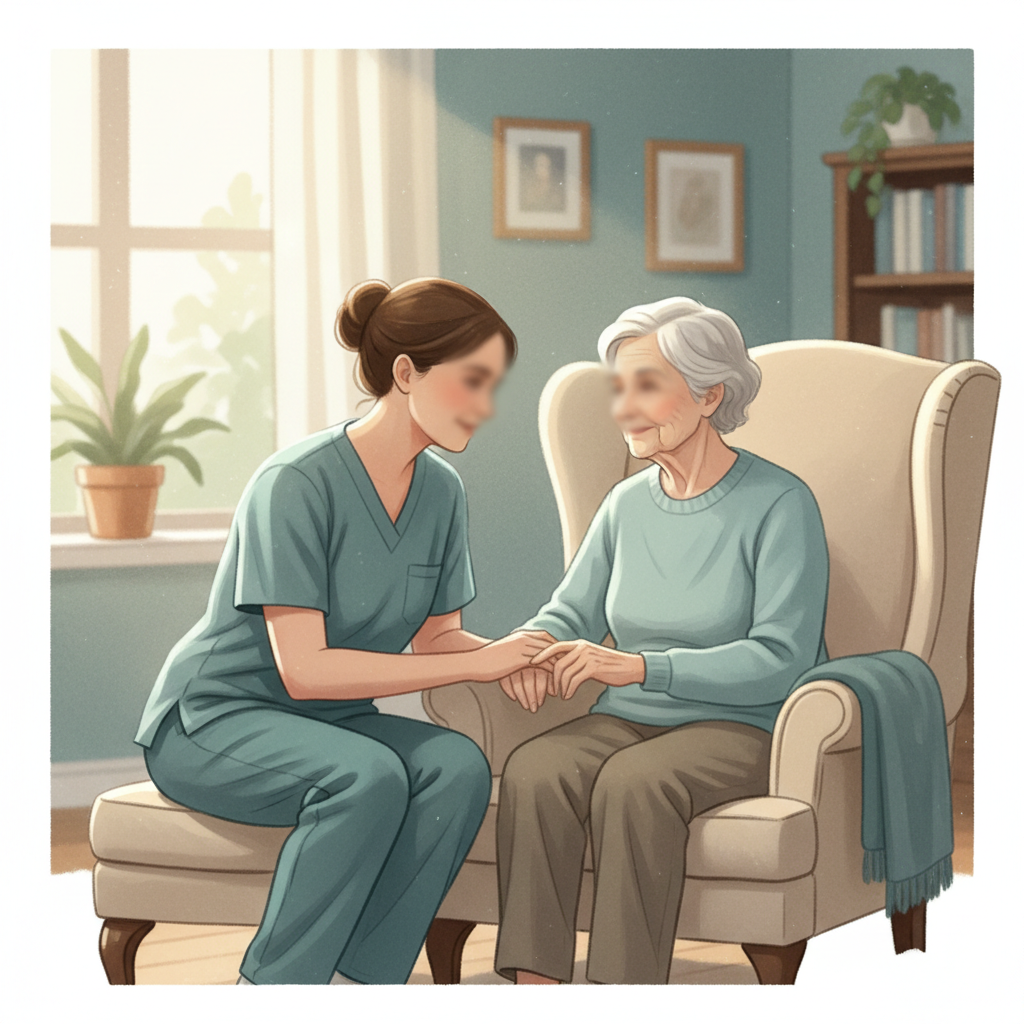
The body-language redirect. When words don't work — when the resident is too far along to process what you're saying — touch does. A hand on the shoulder. Sitting down at eye level. Quiet presence. Most of the time, the resident settles because what they wanted wasn't Sarah specifically. It was someone who felt like Sarah.
What NOT to do
This is where newer CNAs get tripped up:
Don't insist on the correction. "I'm not Sarah, ma'am, I'm your CNA, my name is Jordan." Said three times in a row, with growing frustration, while the resident looks more and more distressed — this is the worst version of the moment. The resident doesn't have the information to update their file. You're asking them to do something their brain can't do.
Don't make it a joke. Laughing it off with coworkers in front of the resident, even when you think they're not tracking, is a real problem. Residents in mid-stage dementia often understand tone and embarrassment even when they can't follow words.
Don't take it personally when you correct them and they get upset. It's not about you. It's about their brain failing in public, which is one of the most vulnerable experiences a human can have.
Don't overuse the play-along. Going along with "you're my daughter" when the resident is asking you to make medical decisions, or to sign something, or to override a real boundary — that's a different situation. Stay in your role.
Don't make it about you. The CNA who posted this said "I almost lost it." That's honest and human. But if you're going to cry in front of the resident every time, that's something to bring to your charge nurse or your own support system. The resident can read the shift in your energy.
How it lands on you
Nobody talks about this part enough.
Being mistaken for a family member — being loved like a daughter, a son, a spouse, by someone who is genuinely feeling it — is one of the most intense emotional experiences in long-term care. It is also one of the most disorienting. You're not family. You go home at the end of the shift. The resident doesn't. The misidentification is happening to both of you, just differently.
Some CNAs handle this by keeping firm boundaries internally. "She called me Sarah 14 times today. I'm not Sarah. I'm a professional doing a job." That's a legitimate way to survive the work.
Other CNAs let themselves feel it. They sit with the resident a little longer. They don't correct the "I love you." They let themselves love back, within role, within shift. They cry in the break room afterward.
Both are fine. What's not fine is doing the work while pretending you don't feel it, or doing the work while believing you have no right to feel it.
Talk to your coworkers. Talk to your charge nurse. Talk to the family if you can — most family members are relieved and grateful when they hear their parent has formed a bond with a CNA. They are not threatened by it. They are usually hoping for exactly this.
What to document
Document when the misidentification is happening, how often, and whether it's causing distress.
- If the resident calls you "Sarah" and is calm about it — brief note, moves on.
- If the resident calls you "Sarah," becomes distressed when you correct them, refuses care because you're "not real" — that's data. The care team needs to know.
- If the resident is asking for a family member by name repeatedly and getting agitated about not seeing them — that's a different conversation with social work, not a CNA-level fix.
The paper trail matters because misidentification patterns shift as dementia progresses. What worked last month may not work this month. The team adjusts the care plan based on what you document.
A note on the long goodbye
For some residents, the misidentification gets worse over time. Eventually they may not recognize their actual family. They may not recognize you either. They may stop calling anyone by name.
If you're the CNA who has been "Sarah" for two years and the resident no longer recognizes you at all — that is a real loss. It is okay to grieve it. It is okay to ask for a few days on a different assignment if you need them. It is okay to remember them.
You are allowed to love people you are losing. That's not weakness. That's the work.
If this kind of post is useful, the full ExamReady library has 1,500+ practice questions, clinical skills with critical-step tracking, and an AI tutor that explains every answer — the same scope-and-voice approach as these posts, with the actual exam tools attached. A 7-day free trial gets you the whole thing, no card required.