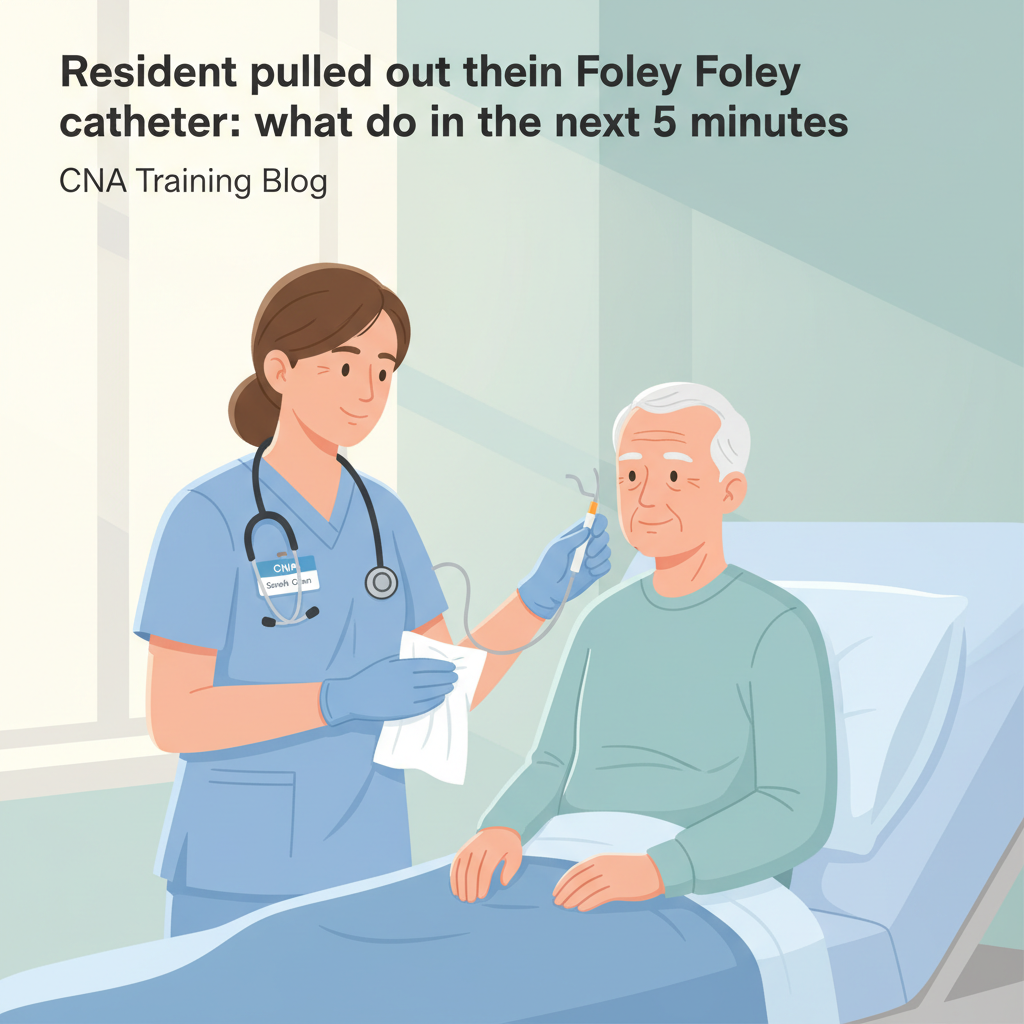
Resident pulled out their own Foley: what to do in the next 5 minutes
A real r/cna question about walking into a room and finding a resident holding their own Foley catheter, balloon and all. What's actually going on, what to do first, and what not to do.
A CNA on r/cna posted this:
I walked into Mr. R's room for his two-hour round and he was just sitting there with his Foley catheter in his hand. Like, the whole thing. Tube, bag, balloon, everything. He looked totally unbothered. There wasn't a ton of blood but there was some, and he said "I just pulled it out, it was bothering me." I froze. I didn't know if I was supposed to put it back in (obviously not, but my brain went there for a second) or just leave it and call the nurse. I put the catheter and bag in a towel and called the nurse and she came in and was like "okay, get him cleaned up, I'll chart it." That's it. No big deal. But I felt like an idiot for not knowing what to do. Did I do this right? What if there had been a lot of blood? What if the resident had been a woman and the catheter had been in for a long time — does that change things?
This kind of post gets a lot of traction because almost every CNA has either lived through it or is terrified it's about to happen. Here's what's actually going on and what the textbook wants from you.
Why residents pull their own catheters
It's almost never about the catheter itself. The catheter is usually a stand-in for something else.
Itching or irritation. The meatus (the opening where the catheter enters) gets itchy. Especially in older men, the tip of the catheter can press against the bladder wall or the prostate, and the resident feels an irritation they can't articulate. They pull it because it bothers them and they don't have a better option.
Confusion. Residents with dementia or delirium don't understand what the tube is. They pull it the way they'd pull a piece of tape off their skin. This is by far the most common cause in SNF settings.
Restlessness. Sundowning, untreated pain, anxiety — any of these can lead a resident to grab whatever is closest, which is often the catheter.
Need to use the bathroom. Counterintuitive but real. The resident has a strong urge to void, doesn't connect the urge to the catheter already draining their bladder, and pulls because their brain says "go."
Discomfort from the bag. A full bag, a bag pulling on the leg strap, a bag positioned wrong — all of these cause residents to tug and pull.
Knowing which one is happening matters because the prevention strategy is different for each. A confused resident needs a different intervention than a resident who's itching.
What to do in the next 5 minutes
The order matters. Walk yourself through it out loud if you have to.
1. Stay calm. The resident is reading your face. If you panic, they panic. Most of the time the resident has done this without any major complication — your job is to keep it that way.
2. Assess the resident, not the catheter. Before you do anything else, look at the person. Are they in pain? Bleeding heavily? Pale, sweaty, lightheaded? Are they breathing okay? Is their mental status their normal, or have they suddenly gotten confused? A small amount of blood from the urethral meatus is common after a self-removal and is usually not an emergency. A large amount, severe pain, or a resident who is suddenly altered — those are emergencies. Call the nurse immediately and flag it as urgent.
3. Don't try to reinsert the catheter. This is the part that trips people up. Reinserting a Foley is out of scope for a CNA in every state. Even if you have watched it done a hundred times, even if the catheter is right there and clean, even if the resident is asking you to put it back. The risk of introducing infection or causing urethral trauma is real, and the liability is real. Leave reinsertion to the nurse or the provider.
4. Cover the resident. Get a clean gown or brief on them. A resident who has just pulled a catheter is often exposed, and exposure adds to the confusion and embarrassment. Cover them first.
5. Assess the catheter itself. Look at it. Was it a Foley with the balloon still inflated, or did the balloon deflate on the way out? Both happen. Either way, do not throw the catheter away — save it in a clean glove or paper towel so the nurse can see what was pulled and how. This helps the nurse and provider document the event and decide next steps.
6. Check for bleeding. Look at the meatus, the bedding, the resident's brief. Small spotting is expected. Heavy bleeding, clots, or bleeding that won't stop with gentle pressure — call the nurse immediately, this is a change in condition.
7. Call the nurse. Report exactly what you found, when you think it happened, how the resident looks now, and any bleeding. Use the SBAR format your facility uses. Don't editorialize ("I think he was trying to get out of bed") — report what you observed ("Resident found sitting at bedside, holding his Foley catheter which had been removed. Small amount of blood at the meatus. Resident alert and oriented to person, denies pain. Catheter saved for nurse to inspect.")
8. Document. After the nurse arrives, document the time you found the resident, the time you called the nurse, the time the nurse arrived, what you observed, and any resident statements verbatim in quotes. Documentation is your protection if anyone later asks why you didn't reinsert the catheter or why you didn't call faster.
What NOT to do
This is where new CNAs get burned.
- Don't reinsert the catheter. Even if you've seen it done. Even if you're trained. It is not within the CNA scope of practice. Period.
- Don't scold the resident. "You shouldn't have done that" is going to land badly with a confused resident, and it won't prevent it from happening again. Redirect.
- Don't hide it. If you find it at the end of shift and don't report it because you're afraid of getting in trouble, you are creating a much bigger problem for yourself. Always report.
- Don't flush the catheter. Some CNAs think they're helping by trying to flush a catheter that's been pulled. Do not. It's out of the resident.
- Don't reposition the resident without assessing first. The urge is to make them comfortable. Take the 10 seconds to look at the situation before you move them.
How to help prevent it next time
After the immediate event is handled, prevention is the conversation.
For confused residents: ask the nurse about a catheter reminder garment, a thigh strap that's harder to reach, or — if this is a pattern — whether the catheter is still clinically necessary. Long-term indwelling catheters in confused residents are a known risk, and many facilities have protocols to evaluate removing them entirely if they're no longer medically required.
For residents with irritation: the nurse can assess whether the catheter size is right, whether the balloon is over-inflated, and whether a different brand or material would be more comfortable.
For everyone: make sure the catheter is secured with a leg strap, the bag is below the bladder, and there is no traction on the tubing. Most self-removals are preceded by days of small tugs. If you notice a resident tugging at their catheter during rounds, mention it to the nurse that shift — don't wait for the removal.
The r/cna poster got it right. Found the resident, didn't reinsert, called the nurse, cleaned them up. The "did I do this right" anxiety that followed is common — and the answer is yes. The only wrong move would have been to try to put it back.
If you want to practice the clinical reasoning for situations like this — Foley care, fall response, code situations, skin tears — the clinical skills section walks through critical steps and common pitfalls with the same scope-of-practice lens.
If this kind of post is useful, the full ExamReady library has 1,500+ practice questions, clinical skills with critical-step tracking, and an AI tutor that explains every answer — the same scope-and-voice approach as these posts, with the actual exam tools attached. A 7-day free trial gets you the whole thing, no card required.