CNA Exam Guide · 2026
Headmaster CNA Practice Test 2026: D&S Diversified CNA Exam Guide
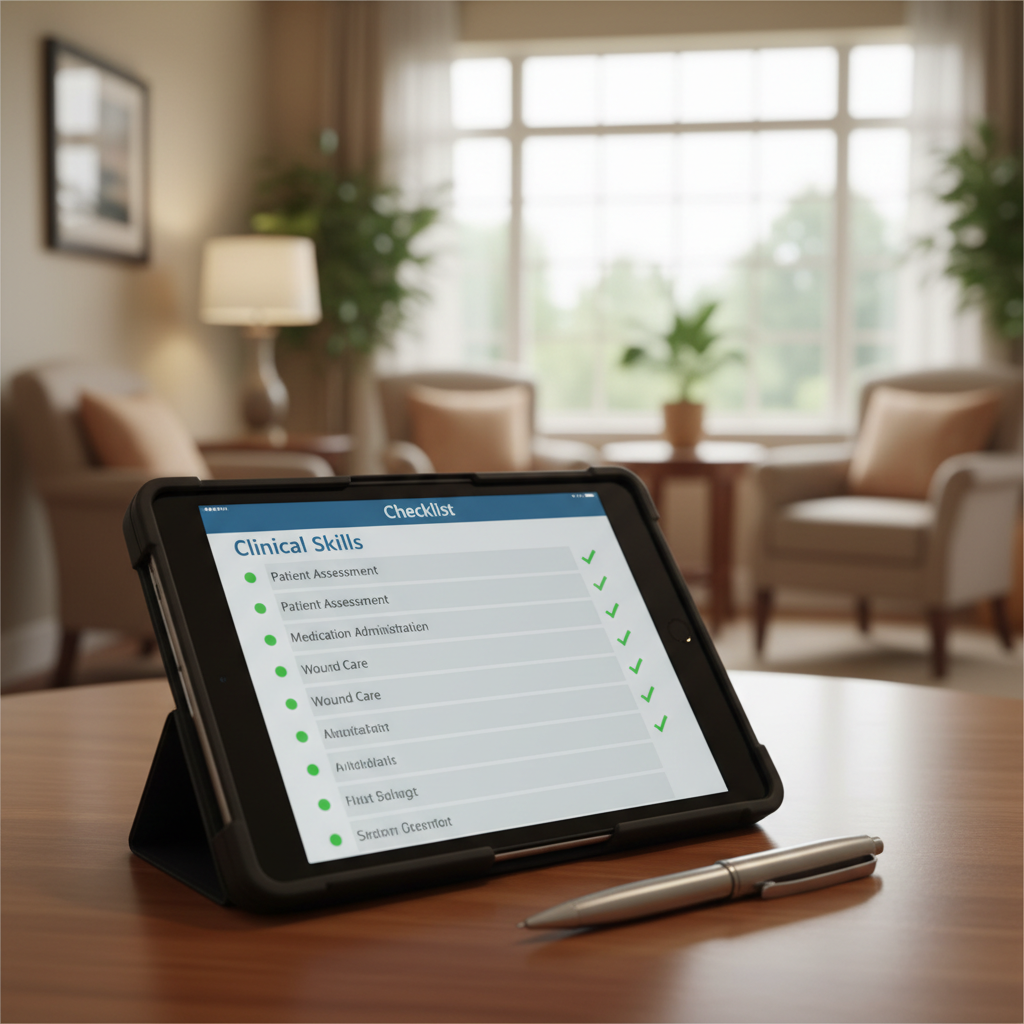
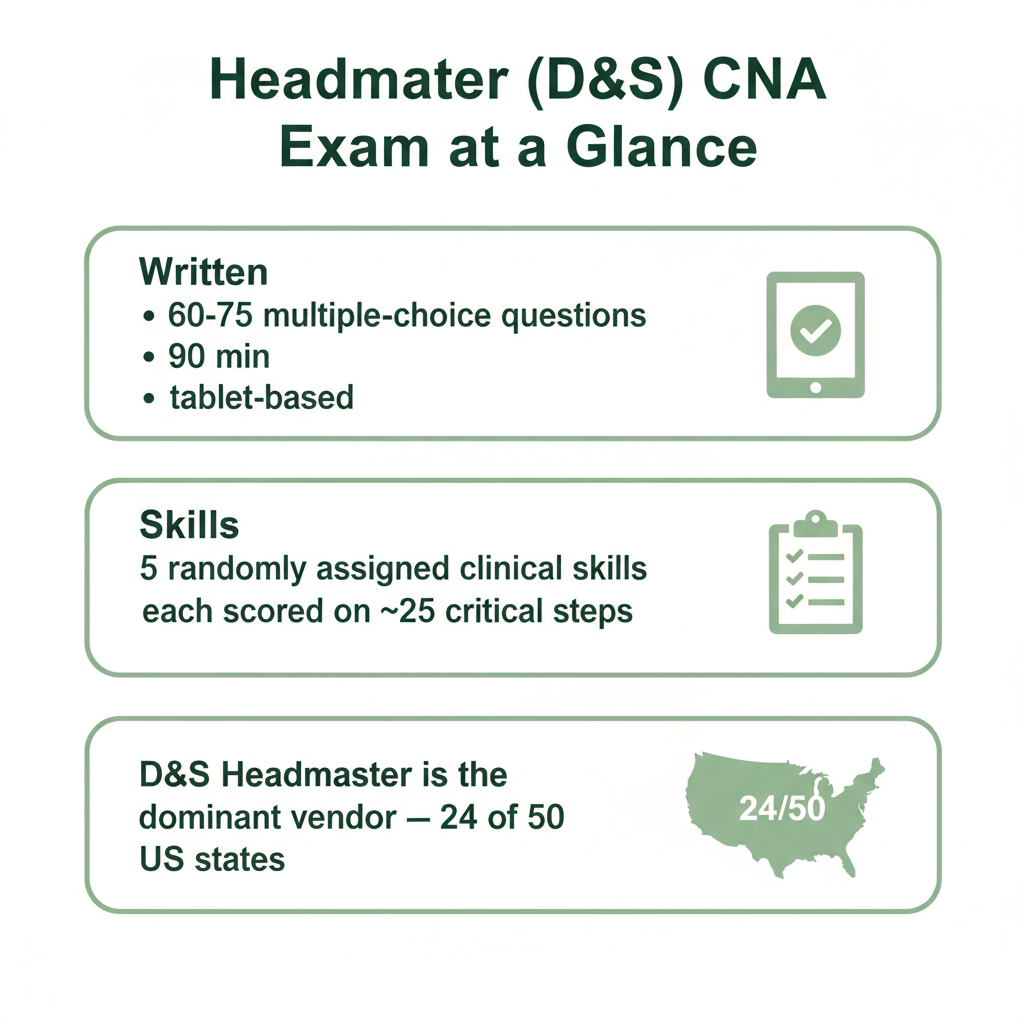
The Headmaster (D&S Diversified) CNA exam is now the most-used nurse aide certification test in the United States by state count, administered to candidates in 24 states. Delivered on a tablet-based platform, the Headmaster exam pairs a 75-question (in most states) written exam with a hands-on clinical skills evaluation. Use this guide to understand exactly what D&S Headmaster tests and how to prepare.
Official vendor portal
Register for the Headmaster (D&S) CNA Exam exam through Headmaster.
States using this exam
24
Questions
60-75
Time limit
90 min
Passing score
75%
Exam fee
$100
Retake limit
3 attempts in 24 months
What is the Headmaster (D&S) CNA Exam?
The Headmaster CNA exam is administered by D&S Diversified Technologies (D&SD-TMU), headquartered in Tennessee. Originally a paper-based test, D&S now uses a tablet-based platform in many testing sites, which allows for faster scoring and a more standardized testing experience. By state count, Headmaster is the dominant CNA exam vendor — more US states use Headmaster than any other vendor, particularly across the Midwest, Mountain West, and parts of the South. The exam follows a content blueprint similar to NNAAP and Prometric, but the testing experience is distinct: candidates interact with a tablet for the written portion and perform clinical skills for an evaluator.
Headmaster (D&S) CNA Exam format: written and skills
Written component
60-75 multiple-choice questions depending on the state. Arizona, Arkansas, Illinois, Indiana, Iowa, Kansas, Kentucky, Michigan, Missouri, Montana, Nebraska, New Mexico, North Dakota, Ohio, Oklahoma, South Dakota, Utah, Wisconsin, and Wyoming have 75 questions. California, Minnesota, Mississippi have 70. Maine and Massachusetts have 60. Delivered on a tablet at a D&S testing site or on paper in some states.
Skills component
5 randomly assigned clinical skills. Hand Hygiene and Indirect Care are always tested. Critical-step rubric: each skill has 2-4 critical steps that must be performed correctly.
Total exam duration: Approximately 90 minutes written + 30-45 minutes for the skills evaluation.
What's tested on the Headmaster (D&S) CNA Exam: content area weights
The Headmaster (D&S) CNA Exam written exam draws questions from 5 content areas. Below is the percentage of questions that fall into each area on a typical state exam.
Which states use the Headmaster (D&S) CNA Exam?
24 US states currently use Headmaster (D&S) CNA Exam for nurse aide certification.
| State | Questions | Exam fee |
|---|---|---|
| AZArizona | 75 | $100 |
| ARArkansas | 75 | $100 |
| CACalifornia | 70 | $100 |
| ILIllinois | 75 | $100 |
| INIndiana | 75 | $100 |
| IAIowa | 75 | $100 |
| KSKansas | 75 | $100 |
| KYKentucky | 75 | $100 |
| MEMaine | 75 | $100 |
| MAMassachusetts | 60 | $100 |
| MIMichigan | 75 | $100 |
| MNMinnesota | 70 | $100 |
| MSMississippi | 70 | $100 |
| MOMissouri | 75 | $100 |
| MTMontana | 75 | $100 |
| NENebraska | 75 | $100 |
| NMNew Mexico | 75 | $100 |
| NDNorth Dakota | 75 | $100 |
| OHOhio | 75 | $100 |
| OKOklahoma | 75 | $100 |
| SDSouth Dakota | 75 | $100 |
| UTUtah | 75 | $100 |
| WIWisconsin | 75 | $100 |
| WYWyoming | 75 | $100 |
How to apply for the Headmaster (D&S) CNA Exam
- 1
Complete a state-approved CNA training program
75+ training hours with at least 16 clinical hours. Some Headmaster states require additional hours.
- 2
Apply through D&S Diversified
Create an account on the D&S Headmaster website, complete your state's eligibility application, and pay the exam fee.
Open the vendor site - 3
Schedule your exam
D&S operates regional testing sites across the 24 states it serves. Most candidates can find a site within 60 miles.
- 4
Pass the tablet-based written and skills evaluation
The tablet-based format lets you flag questions for review and submit with confidence. Plan for ~3 hours total at the testing site.
Headmaster (D&S) CNA Exam exam day: what to bring and expect
- Bring: Two forms of government-issued ID, your D&S scheduling confirmation, and any program-completion forms.
- Dress code: Scrubs or casual professional attire, closed-toe non-slip shoes, hair tied back, no jewelry that interferes with skills.
- Tablet interface: The D&S tablet has a tutorial at the start of the written exam — pay attention to it. You can flag questions for review, change answers, and submit at your own pace.
- Arrival time: 30 minutes before your scheduled time.
- Results: Most D&S sites give written-exam results the same day via your online account; skills results within 10 business days.
Headmaster (D&S) CNA Exam pass rates and difficulty
D&S Headmaster reports first-attempt pass rates in the 80-86% range, though this varies by state and testing cohort. The skills portion is the most common point of failure — specifically, candidates who skip the hand-hygiene step at the start of a skills demonstration are flagged as failing. Tablet-format candidates report the experience as more comfortable than paper, with fewer technical issues than older platforms.
Headmaster (D&S) CNA Exam cost and fees
- Written exam$75 (state dependent)
- Skills exam$75 (state dependent)
- Combined written + skills$100 (typical)
- Retake fee$75 per component
- Late reschedule fee$25 if rescheduled less than 5 business days before the exam
How is the Headmaster (D&S) CNA Exam graded?
Headmaster's written exam is delivered on a tablet and scored immediately at the testing center. The minimum passing score is 75% (most states) — a stricter threshold than NNAAP's 70%. The clinical skills portion is graded by a Registered Nurse evaluator using the same critical-step rubric as other NNAAP-aligned vendors: every critical step on every skill must be performed correctly, in order. Missing even one critical step fails that entire skill, and failing one skill fails the entire skills portion. D&S posts your official score report to your online candidate account within 5-10 business days. The report includes your written exam score (broken down by content area) and a pass/fail for each of the 5 clinical skills. Most states allow up to 3 attempts within 24 months of training completion, with a per-component retake fee of $60-$80. D&S also offers a free post-exam review for candidates who fail — ask the testing center about this option before leaving the site.
Headmaster (D&S) CNA Exam clinical skills you'll be tested on
Every CNA candidate performs 5 randomly assigned clinical skills from a vendor-approved list. Two skills — hand hygiene and indirect care — are always tested. The remaining 3 are drawn from the list below. Each skill has a critical-step checklist; missing even one critical step fails that entire skill.
Hand Hygiene
1 critical stepThe 8-step handwashing sequence using soap and water (or alcohol-based handrub). Always tested as one of the 5 skills.
Indirect Care
1 critical stepKnock, introduce yourself, verify patient identity, provide privacy, and explain the procedure before any skill. Always tested.
Bed Bath (Complete or Partial)
2 critical stepsWash the resident from head to toe (or upper body only for partial), maintaining privacy and dignity throughout.
Oral Care
2 critical stepsBrush teeth, gums, and tongue using a soft-bristled toothbrush. Provide oral care for unconscious residents using a swab.
Perineal Care
2 critical stepsClean the perineal area from front to back. Privacy and dignity are graded as critical steps.
Vital Signs
1 critical stepTake and record temperature, pulse, respiration, and blood pressure correctly. Report abnormal values to the nurse.
Blood Pressure
1 critical stepUse the correct cuff size, position the arm at heart level, and inflate to the appropriate pressure.
Feeding
2 critical stepsPosition the resident upright, offer fluids between bites, and place food on the unaffected side of the mouth for stroke residents.
Ambulation
2 critical stepsWalk with the resident using a gait belt, supporting the weak side.
Transfer (Bed to Wheelchair)
2 critical stepsUse a gait belt, lock the wheelchair brakes, and pivot safely without twisting the aide's body.
ROM Exercises
1 critical stepPerform passive range-of-motion exercises correctly, supporting the joint while moving it through its full range.
Catheter Care
2 critical stepsProvide perineal care to a resident with an indwelling catheter, cleaning from the urethra outward.
How to prepare for the Headmaster (D&S) CNA Exam
The D&S Headmaster candidate handbook is your bible — it includes the exact content areas, the approved skills list with critical steps, and sample questions. Spend at least two weeks drilling the skills critical-step checklist; every step must be performed in order. Take 3-5 full-length timed practice tests in the final week. Use the tablet tutorial at the start of the actual exam to get comfortable with the interface before tackling the first question. Day-of: eat a real breakfast, hydrate, and arrive early to settle nerves.
Try 5 free Headmaster (D&S) CNA Exam practice questions
Five real-style Headmaster (D&S) CNA Exam questions with instant feedback and explanations. No signup required. Your score stays private. After you finish, you'll see how you did and (if you want) a path to the full 1,500+ question bank.
Try 5 practice questions — Headmaster
Question 1 of 5
Score: 0
When assisting a resident with dementia to the bathroom, the nurse aide should:
Common mistakes that fail the Headmaster (D&S) CNA Exam
After reviewing hundreds of failed first-attempts across all six CNA exam vendors, the same handful of mistakes account for the majority of failures. Skipping these is more important than memorizing every content area.
1.Skipping hand hygiene at the start of a skill
Headmaster scoring follows the same NNAAP-aligned critical-step rubric. Every skills demonstration must begin with hand hygiene. Candidates who skip it fail that skill immediately. The 8-step hand hygiene sequence is identical across all 24 Headmaster states.
2.Not practicing the tablet interface before exam day
Headmaster's tablet-based written exam has a tutorial at the start, but candidates who don't pre-familiarize themselves with the interface waste 5-10 minutes figuring out how to navigate. Take at least 2-3 timed practice tests on a tablet (not a laptop) before exam day so the navigation is muscle memory.
3.Confusing the Headmaster state-by-state question counts
Headmaster states use 60, 70, or 75 questions depending on the state — Maine and Massachusetts have 60, while 19 other states have 75. Candidates who over-prepare for the wrong count waste study time. Verify your state's exact count on the D&S website before scheduling.
4.Forgetting to verify the patient identity
Headmaster evaluators are strict about patient identification. Asking the patient's name is not enough — you must check the wristband or ask a staff member to confirm. Skipping this critical step costs you the entire skill.
5.Not reading the skill assignment carefully
Headmaster's skill card can be ambiguous if read quickly. 'Modified bed bath' and 'partial bed bath' have different setups. 'Catheter care' and 'perineal care' overlap. Read the assignment twice before picking up any equipment.
Headmaster (D&S) CNA Exam sample questions (with answers)
These questions mirror the format and difficulty you'll see on the Headmaster (D&S) CNA Exam exam. After choosing your answer, expand the explanation to see why it's correct and what concept it tests. Use these as a self-check before scheduling your real exam.
Q1.When assisting a resident with dementia to the bathroom, the nurse aide should:
- Rush the resident to avoid accidents
- Speak in short, simple sentences(Correct)
- Use complex medical terminology
- Perform the task without explaining
Show explanation
Residents with dementia process information more easily when it's presented in short, simple sentences. Rushing, using medical terminology, or skipping explanation all increase confusion and the risk of resistance. This tests the dementia-care content area that Headmaster emphasizes.
Q2.The nurse aide is preparing to provide perineal care to a resident. Before beginning, the aide should:
- Lower the lights to reduce stimulation
- Provide privacy by closing the door and curtain(Correct)
- Apply lotion to the perineal area
- Position the resident supine
Show explanation
Privacy is the first step in any perineal care procedure. Closing the door and curtain preserves dignity. Lowering lights doesn't help, applying lotion is premature, and supine positioning may not be appropriate for all residents. This tests the privacy-and-dignity standard Headmaster emphasizes.
Q3.When taking a resident's oral temperature with a digital thermometer, the nurse aide should:
- Use the same probe cover for multiple readings to save supplies
- Place the probe under the resident's tongue(Correct)
- Hold the thermometer in place for 30 seconds regardless of reading
- Record the temperature 1 hour after measurement
Show explanation
Placing the probe under the resident's tongue (in the sublingual pocket) is the correct technique. Probe covers should not be reused. Recording should be immediate. This tests the vital-signs content area that Headmaster emphasizes.
What happens if you fail the Headmaster (D&S) CNA Exam
If you fail the Headmaster (D&S) CNA exam, D&S posts your score report to your online candidate account within 5-10 business days. The report breaks down your performance by content area and by skill, so you know exactly what to study. Most states allow up to 3 attempts within 24 months of training completion, with a retake fee of $60-$80 per component. The clinical skills portion is the most common point of failure, and within that portion, hand hygiene at the start of a skill is the most-skipped critical step. Tablet-format candidates sometimes also struggle with the interface on the first attempt — unfamiliarity with the navigation can cost you 5-10 minutes and lead to careless errors. For your retake, focus on the content areas where you scored lowest and re-practice the specific skills you missed. Most candidates who fail on the first attempt pass on the second try. D&S also offers candidate performance reports that show which critical steps you missed on each skill, so you can target your preparation.
Headmaster (D&S) CNA Exam frequently asked questions
How many questions are on the Headmaster CNA exam?▾
Most Headmaster states have 75 multiple-choice questions on the written exam; some have 70 or 60. The exam is delivered on a tablet or on paper depending on the testing site.
What is the passing score for the Headmaster CNA exam?▾
Most states require 75% or higher on the written portion. Some states require 70%. The skills portion requires every critical step to be passed.
How long does it take to get Headmaster CNA results?▾
Written exam results are typically available the same day at the testing center. Skills results arrive within 5-10 business days via your online D&S account.
Can I retake the Headmaster CNA exam?▾
Yes. Most states allow 3 attempts within 24 months of training completion.
What is the difference between Headmaster and NNAAP?▾
Headmaster is administered by D&S Diversified on a tablet-based platform in 24 states; NNAAP is administered by Credentia or Pearson VUE on computer or paper in fewer states. The content blueprint is similar but the testing experience and the candidate handbook are different.
Is the Headmaster CNA exam hard?▾
Like the NNAAP, the Headmaster exam is challenging but passable for candidates who complete their training program. The clinical skills portion is the most common point of failure.
How do I register for the Headmaster CNA exam?▾
Visit hdmaster.com, create an account, complete your state's eligibility application, pay the fee, and schedule at a regional D&S testing site.
Related exam guides
NNAAP CNA exam guide
Learn about the NNAAP certified nurse aide exam — format, states, fees, and how to prepare.
Prometric CNA exam guide
Learn about the Prometric certified nurse aide exam — format, states, fees, and how to prepare.
Credentia CNA exam guide
Learn about the Credentia certified nurse aide exam — format, states, fees, and how to prepare.
PHD CNA exam guide
Learn about the PHD certified nurse aide exam — format, states, fees, and how to prepare.
Excel Testing CNA exam guide
Learn about the Excel Testing certified nurse aide exam — format, states, fees, and how to prepare.