CNA Exam Guide · 2026
NNAAP CNA Practice Test 2026: The Complete Credentia NNAAP Exam Guide
The NNAAP (National Nurse Aide Assessment Program) is the most widely recognized CNA certification exam in the United States. Administered by Credentia, it combines a 70-question written exam with a hands-on clinical skills evaluation covering 5 randomly assigned nursing procedures. Use this guide to understand exactly what's tested, how the exam is scored, and how to prepare on your first try.
Official vendor portal
Register for the NNAAP exam through NNAAP.
States using this exam
2
Questions
70
Time limit
90 min
Passing score
70%
Exam fee
$100
Retake limit
3 attempts in 24 months
What is the NNAAP?
The NNAAP — short for National Nurse Aide Assessment Program — is the standardized certification exam used by state nursing boards to verify that candidates are competent to work as certified nurse aides (CNAs). Developed by the National Council of State Boards of Nursing (NCSBN), the exam has two parts: a multiple-choice written exam and a clinical skills evaluation. The NNAAP is administered by Credentia in some states and by Pearson VUE in others — both follow the same content blueprint. The exam is required in every US state before a candidate can be listed on the state nurse aide registry, although the specific vendor administering it varies.
NNAAP format: written and skills
Written component
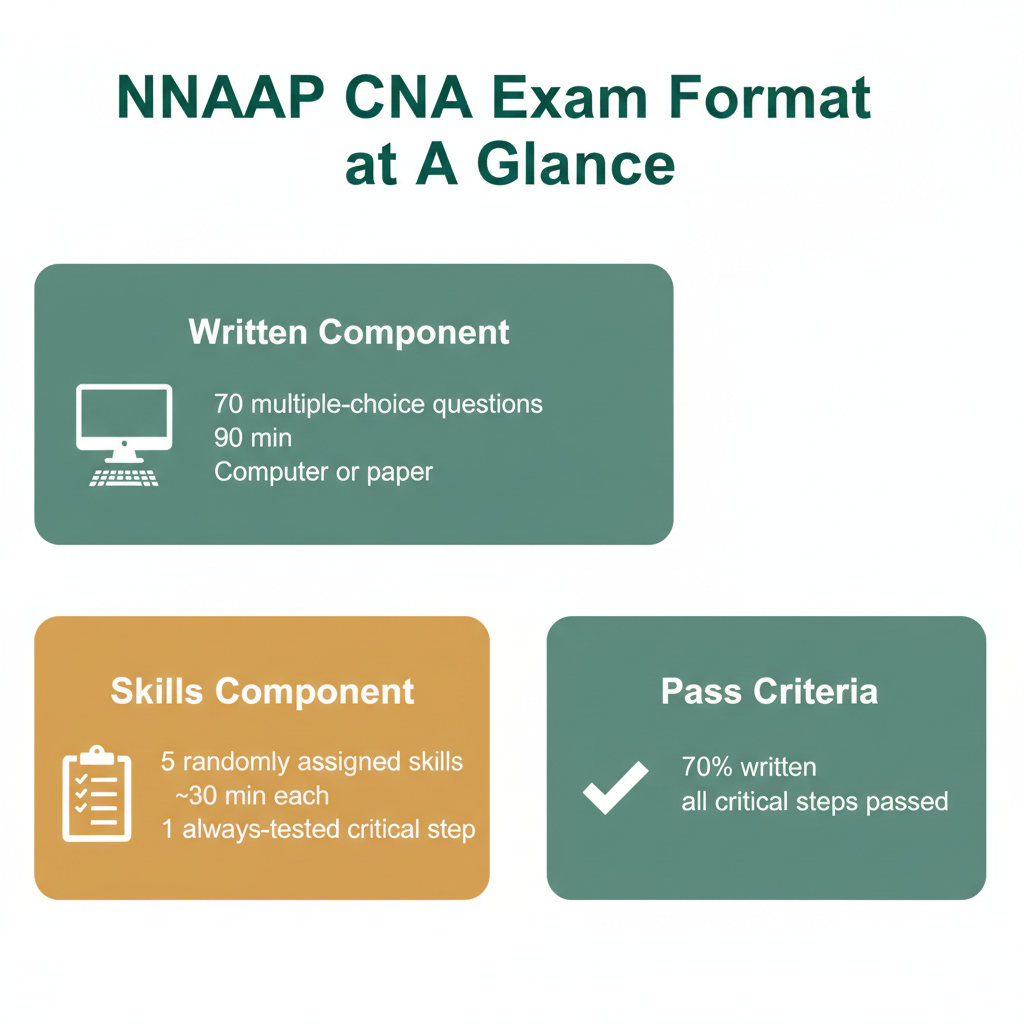
70 multiple-choice questions covering Role of the Nurse Aide, Physical Care, Psychosocial Care, and Safety. Administered by computer at a testing center or on paper in some states. You have 90 minutes to complete the written portion. Each question has exactly one correct answer.
Skills component
5 randomly assigned clinical skills performed in front of a Registered Nurse evaluator. Each skill has 1-3 critical steps that must be performed correctly. Hand Hygiene and Indirect Care are always tested; the remaining 3 are drawn from a pool of 22 NNAAP skills.
Total exam duration: 90 minutes written + approximately 30-45 minutes for the skills evaluation, depending on the skills assigned.
What's tested on the NNAAP: content area weights
The NNAAP written exam draws questions from 5 content areas. Below is the percentage of questions that fall into each area on a typical state exam.
Which states use the NNAAP?
2 US states currently use NNAAP for nurse aide certification.
| State | Questions | Exam fee |
|---|---|---|
| ALAlabama | 70 | $100 |
| PAPennsylvania | 70 | $100 |
How to apply for the NNAAP
- 1
Complete a state-approved CNA training program
Before you can register for the NNAAP, you must graduate from a state-approved nurse aide training program — typically 75 hours of training including 16 clinical hours.
- 2
Apply through your state's testing vendor
Each state that uses the NNAAP works with either Credentia or Pearson VUE to schedule candidates. Most programs submit your eligibility automatically after graduation.
- 3
Pay the exam fee
The fee is typically $100 for the full exam (written + skills) or $60-$80 for a single component retake. Some states subsidize the fee for students who completed training at a public institution.
- 4
Schedule your exam
After your application is approved, you'll receive instructions to schedule at a nearby testing site. Slots fill quickly — schedule within 30 days of eligibility.
Open the vendor site
NNAAP exam day: what to bring and expect
- Bring: Two forms of government-issued ID (one with photo), your scheduling confirmation, and any required forms from your training program.
- Dress code: Wear flat closed-toe shoes with non-slip soles. Scrubs are recommended but not required. Long hair must be tied back.
- What to leave at home: Cell phones, smartwatches, food, drinks, study materials, and bags. Lockers are typically provided.
- Arrival time: Arrive 30 minutes before your scheduled time to allow for check-in and ID verification.
- Scoring: Results are typically available the same day for the written portion (computer-based) or within 10 business days for the skills portion.
NNAAP pass rates and difficulty
Pass rates for the NNAAP vary by state and testing cohort, but Credentia reports first-attempt pass rates typically in the 75-85% range for graduates of state-approved training programs. The most common reasons for failure are skipping steps during the clinical skills evaluation (especially hand hygiene) and running out of time on the written exam. Most candidates who fail on the first attempt pass on a second try after focused review of the critical-step rubric.
NNAAP cost and fees
- Written exam$60-$80 (state dependent)
- Skills exam$60-$80 (state dependent)
- Combined written + skills$100 (typical)
- Retake fee$60-$80 per component
- Training program (separate)$500-$2,000 at a community college or vocational school
How is the NNAAP graded?
The NNAAP uses a two-part scoring system. The written exam is scored immediately at the testing center for computer-based testing, or within 10 business days for paper-based testing. You need a minimum score of 70% to pass the written portion. The clinical skills portion is graded by a Registered Nurse evaluator who watches your performance and checks each step against a vendor-approved critical-step rubric. To pass the skills portion, every critical step must be performed correctly, in order. Missing even one critical step fails the entire skill — and missing one critical step in any of the 5 skills fails the entire skills exam, regardless of how well you performed on the other 4. There is no partial credit on skills. You don't need to pass both portions on the same day — most states allow you to retake just the failed portion. If you fail only the skills, you can retake only the skills portion (typically $60-$80) without re-doing the written exam. This is the most cost-effective retake strategy.
NNAAP clinical skills you'll be tested on
Every CNA candidate performs 5 randomly assigned clinical skills from a vendor-approved list. Two skills — hand hygiene and indirect care — are always tested. The remaining 3 are drawn from the list below. Each skill has a critical-step checklist; missing even one critical step fails that entire skill.
Hand Hygiene
1 critical stepThe 8-step handwashing sequence using soap and water (or alcohol-based handrub). Always tested as one of the 5 skills.
Indirect Care
1 critical stepKnock, introduce yourself, verify patient identity, provide privacy, and explain the procedure before any skill. Always tested as one of the 5 skills.
Bed Bath (Complete or Partial)
2 critical stepsWash the resident from head to toe (or upper body only for partial), maintaining privacy and dignity throughout. Use the correct water temperature and change water when soapy or cold.
Oral Care
2 critical stepsBrush the resident's teeth, gums, and tongue using a soft-bristled toothbrush. Provide oral care for an unconscious resident using a swab.
Perineal Care
2 critical stepsClean the perineal area from front to back to prevent infection. Always done on a resident of the opposite gender than the aide to test the privacy-and-dignity standard.
Dressing
1 critical stepDress or undress the resident while supporting the weak side first. Use adaptive clothing if the resident has range-of-motion limitations.
Bedpan Use
2 critical stepsPosition the bedpan correctly, provide privacy, leave the call light within reach, and remove the bedpan without soiling the linens.
Vital Signs
1 critical stepTake and record temperature, pulse, respiration, and blood pressure correctly. Recognize values outside the normal range and report them.
Blood Pressure
1 critical stepUse the correct cuff size, position the resident's arm at heart level, and inflate the cuff to the appropriate pressure. Report readings outside the normal range.
Feeding
2 critical stepsPosition the resident upright, offer fluids between bites, and place food on the unaffected side of the mouth for stroke residents. Recognize aspiration risk.
Ambulation
2 critical stepsWalk with the resident using a gait belt, supporting the weak side. Position yourself on the weaker side and let the resident set the pace.
Transfer (Bed to Wheelchair)
2 critical stepsUse a gait belt, lock the wheelchair brakes, position the resident's feet correctly, and pivot safely without twisting the aide's body.
How to prepare for the NNAAP
Most successful candidates spend 4-6 weeks studying after completing their training program. A solid prep plan: (1) take a full-length practice test to identify weak areas; (2) review each NNAAP clinical skill with focus on the critical-step checklist — every step must be performed in order; (3) drill 20-30 multiple-choice questions per day covering the four content areas; (4) do at least one full timed practice test in the week before your exam so you're not surprised by the format. Skip none of the critical steps on skills — failing even one critical step fails the entire skills exam. Time management matters: most candidates who run out of time on the written exam have spent too long on early questions.
Try 5 free NNAAP practice questions
Five real-style NNAAP questions with instant feedback and explanations. No signup required. Your score stays private. After you finish, you'll see how you did and (if you want) a path to the full 1,500+ question bank.
Try 5 practice questions — NNAAP
Question 1 of 5
Score: 0
How long should you rub your hands together when performing hand hygiene?
Common mistakes that fail the NNAAP
After reviewing hundreds of failed first-attempts across all six CNA exam vendors, the same handful of mistakes account for the majority of failures. Skipping these is more important than memorizing every content area.
1.Skipping hand hygiene at the start of a skill
Every NNAAP skills demonstration must begin with hand hygiene — it's the very first step the evaluator scores. Candidates who jump straight to the skill task fail this critical step immediately, regardless of how well they perform the rest. The evaluator doesn't pause or warn you; once you've moved past hand hygiene, you've lost the point. Memorize the 8-step hand hygiene sequence and treat it as automatic, like buckling a seat belt.
2.Forgetting to introduce yourself and verify patient identity
At the start of every NNAAP skill, you must knock, introduce yourself by name, identify the patient by checking their wristband, and explain what you're about to do. Skipping these 'indirect care' steps costs you points and signals to the evaluator that you're rushing. Practice the opening ritual until it's muscle memory.
3.Running out of time on the written exam
70 questions in 90 minutes sounds generous, but candidates who spend too long on early questions run out of time at #55-60. Mark difficult questions for review and move on. Aim for ~1 minute per question with 10-15 minutes left for review of marked items. Candidates who pass typically finish the first pass with 15-20 minutes to spare.
4.Confusing similar-sounding skills
Perineal care vs. catheter care, partial bath vs. complete bed bath, ROM vs. ambulation — these skills have overlapping setups but distinct execution steps. Candidates who skim the skill card and start without reading carefully often perform the wrong skill entirely. Read the candidate's skill assignment twice before picking up any equipment.
5.Not providing privacy throughout the skill
Pulling the privacy curtain is a critical step that must happen before any patient exposure and remain in place for the duration. Candidates who pull the curtain at the start but forget to re-pull it after repositioning the patient lose points. Privacy is a continuous state, not a one-time action.
NNAAP sample questions (with answers)
These questions mirror the format and difficulty you'll see on the NNAAP exam. After choosing your answer, expand the explanation to see why it's correct and what concept it tests. Use these as a self-check before scheduling your real exam.
Q1.A resident refuses to eat breakfast. What should the nurse aide do FIRST?
- Document the refusal in the chart
- Notify the charge nurse immediately
- Ask the resident why they don't want to eat(Correct)
- Remove the tray and try again at lunch
Show explanation
The first action is to engage with the resident directly to understand the reason for refusal. Documenting and notifying come after addressing the resident. This tests the 'psychosocial care' content area and the priority-of-action sequence that NNAAP frequently tests.
Q2.When performing hand hygiene, the minimum amount of time to rub hands together with soap is:
- 5 seconds
- 10 seconds
- 20 seconds(Correct)
- 60 seconds
Show explanation
The CDC standard for handwashing is 20 seconds of friction with soap. This is one of the most-tested facts on the NNAAP written exam and the corresponding hand hygiene skill is always tested in the clinical portion. Memorize 20 seconds — it shows up across all six CNA exam vendors.
Q3.While transferring a resident from bed to wheelchair, the resident begins to fall. The nurse aide should:
- Catch the resident and lower to the floor(Correct)
- Call for help and continue the transfer
- Hold the resident upright until help arrives
- Push the resident back onto the bed
Show explanation
When a resident falls during transfer, the nurse aide should never try to catch them — instead, ease them to the floor to prevent injury to both parties. This tests the safety content area and is one of the highest-weighted NNAAP scenarios.
What happens if you fail the NNAAP
If you fail the NNAAP, you're not alone — about 15-25% of first-attempt candidates don't pass. Most candidates who fail do so on the clinical skills portion, not the written exam, and the most common failure mode is skipping a critical step (most often hand hygiene at the start of a skill). The good news is the failure is recoverable. Most states allow up to 3 attempts within 24 months of training completion. The retake fee is typically $60-$80 per component, so retaking just the part you failed (just the skills, or just the written) is cheaper than the full exam. Contact your training program — many offer free re-prep sessions for graduates who fail. Between attempts, focus on the specific skill or content area where you scored lowest. Credentia provides a candidate performance report that breaks down which content areas you missed, so you know exactly what to study. Most candidates who fail on the first attempt pass on the second try, often with no additional prep beyond reviewing the report and re-practicing the missed skill 3-5 times. Don't panic, don't give up, and don't skip the post-exam review. The exam isn't going anywhere, and the path to passing it is well-trodden.
NNAAP frequently asked questions
How many questions are on the NNAAP?▾
The NNAAP written exam has 70 multiple-choice questions. You have 90 minutes to complete it.
What is the passing score for the NNAAP?▾
Most states require a score of 70% or higher to pass the written portion. The skills portion requires every critical step to be performed correctly.
How long does it take to get NNAAP results?▾
Computer-based written exam results are usually available the same day at the testing center. Paper-based and skills exam results are typically available within 10 business days.
Can I retake the NNAAP if I fail?▾
Yes. Most states allow up to 3 attempts within 24 months of training completion. You can usually retake individual components (just written, or just skills) — check with your state board for specifics.
Which states use the NNAAP?▾
Several US states use the NNAAP, administered either by Credentia or Pearson VUE. Use the table above for the current list.
What is the difference between NNAAP and a state-specific exam?▾
The NNAAP is the standardized national exam developed by the NCSBN and used by multiple states. State-specific exams (like Headmaster or Prometric) are designed and administered by a different vendor, often with the same content blueprint but a distinct testing experience.
Is the NNAAP hard?▾
The NNAAP is challenging but passable for candidates who completed their training program. The hardest part for most people is the clinical skills evaluation — every critical step must be performed correctly, in order, without skipping.
Related exam guides
Prometric CNA exam guide
Learn about the Prometric certified nurse aide exam — format, states, fees, and how to prepare.
Headmaster CNA exam guide
Learn about the Headmaster certified nurse aide exam — format, states, fees, and how to prepare.
Credentia CNA exam guide
Learn about the Credentia certified nurse aide exam — format, states, fees, and how to prepare.
PHD CNA exam guide
Learn about the PHD certified nurse aide exam — format, states, fees, and how to prepare.
Excel Testing CNA exam guide
Learn about the Excel Testing certified nurse aide exam — format, states, fees, and how to prepare.