Resident hits, scratches, or bites you: how to handle it without getting hurt or fired
A CNA on r/cna asked what to do when a confused resident keeps grabbing, hitting, and scratching during care. Why it's never your fault, what your facility has to do, and the exact steps to take in the moment.
A CNA on r/cna posted this:
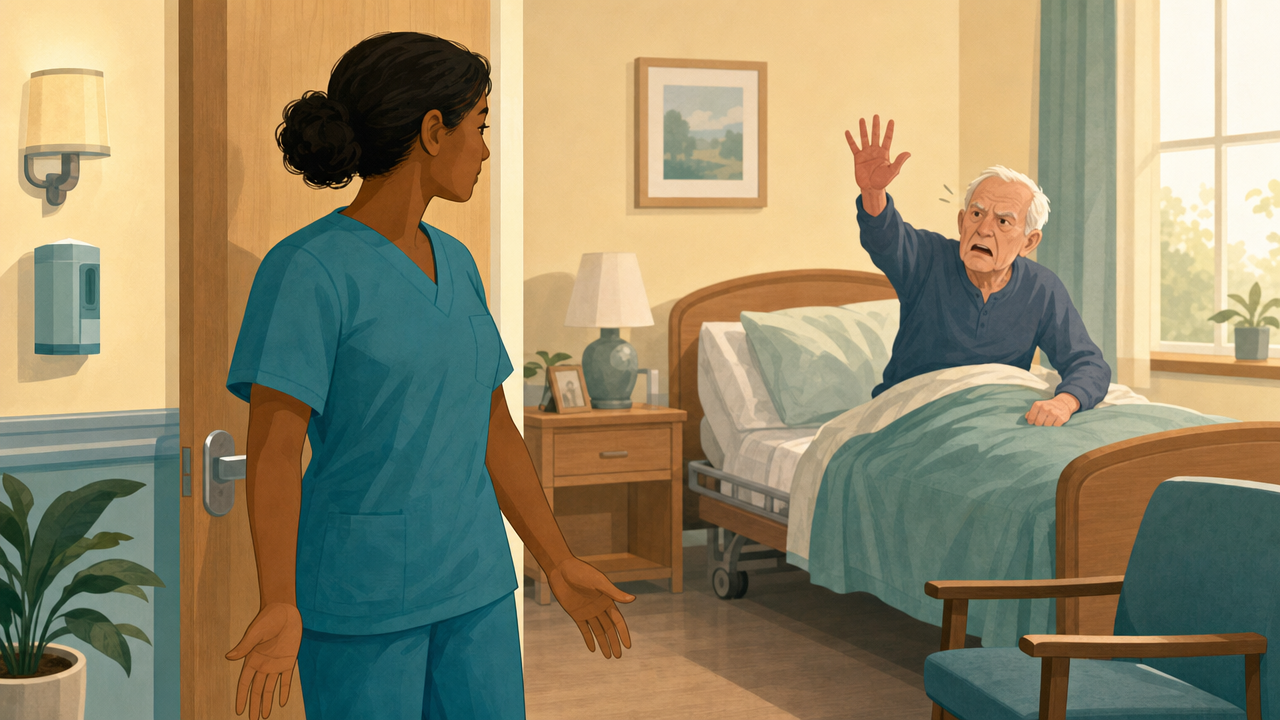
I work nights at a SNF and there's a resident who is sundowning HARD lately. Every time I try to do peri-care or change him, he grabs my wrist, scratches my arms, and last night he bit my forearm through my sleeve hard enough to leave a mark. I'm 5'2 and he's a big guy. My charge nurse just keeps saying "he's not himself right now, redirect him," but redirecting doesn't work when he's already grabbed me. I've started dreading going into his room. Is there a right way to handle this or am I just supposed to take it?
This post got 412 upvotes and 188 comments. It's one of the most under-discussed parts of CNA work: what you do when a resident is physically aggressive toward you, and the "just redirect" advice isn't working. Here's the actual answer.
First: this is never your fault, and it's not "just part of the job"
If a resident hits, grabs, scratches, kicks, bites, or spits on you, that is an assault in the legal sense — even when the resident is confused, even when they "didn't mean it," even when they're five times your size. That changes the conversation from "how do I be a better CNA" to "how does my facility protect me from a workplace injury." Those are different conversations, and the second one is the one your facility owes you.
You do not have a duty to absorb injury. You have a duty to provide safe care. When safe care is impossible because the resident is in an acute aggressive episode, your job is to step out, get help, and document.
Why "just redirect" fails when it fails
"Redirect" works for mild confusion, anxiety, and boredom. It does not work when the resident is in pain, in an acute delirium (UTI, dehydration, medication change), sundowning severely, or perceiving care itself as a threat — being touched, having clothes removed, being rolled. It also doesn't work if the resident doesn't recognize or trust you. "Just redirect" is the first-line response, not the only response. If you've tried it and it's not working, escalating is correct.
What to do in the moment — the actual steps
1. Stop the care. The instant a hand grabs you, a fist swings, or a bite lands, you stop. Step back out of arm's reach. The task is not more important than your body.
2. Get to a safe distance. Step outside the room or to the far wall. Close the door if the resident is mobile — you want a barrier. Keep your voice low and your body non-threatening.
3. Call for help. Yell down the hall, hit the call light, use your walkie. The words that get the right response are specific: "I need help in room [X], resident is actively aggressive, I'm out of the room." "I'm having trouble" gets you a redirect. "Active aggression" gets you another body.
4. Do not re-engage alone. Two-staff care for an actively aggressive resident is the standard, not optional. If your facility is telling you to go back in by yourself, that is a documentation problem for them, not a performance problem for you.
5. Check yourself for injury and report it the same shift. Bites especially need to be reported and cleaned immediately — human bites have a high infection rate. Report even minor scratches and verbal aggression. Reporting matters because it creates the paper trail that triggers a care-plan review, puts the resident on the team's radar, and protects you if the injury flares up later.
What the facility has to do after a pattern
When a resident has multiple aggressive incidents — not a one-off but a pattern — the facility has a multi-step obligation:
- Behavior tracking. Every incident gets charted: time, triggers, what worked, what didn't. Your documentation drives this.
- Care-plan review. Updated with specific de-escalation strategies, triggers to avoid, and a minimum-staffing rule (e.g., "two-staff ADL care, never approach from the left"). If it hasn't been updated after multiple incidents, the facility is failing.
- Medical workup. Sudden-onset aggression in a previously calm resident is a red flag for UTI, dehydration, infection, pain, or a medication change. "He's sundowning" is a description, not a workup.
- Staffing. If the resident is too aggressive for safe one-staff care, the facility has to staff for two. They cannot legally require you to provide care that's reasonably certain to injure you.
What NOT to do
Do not restrain the resident yourself. Physical restraint by an unlicensed staff member is almost never within your scope. Grabbing their wrists to "stop them from hitting you" puts you in a legal grey zone even when you started defensively. Get help.
Do not block the hit with your body. It's instinct, but leaning into a swinging arm to "get it over with" turns a near-miss into an injury. Step back. The care can be done later.
Do not take it personally — and do not skip the report. A confused resident who bites you is not rejecting you. They're responding to a stimulus they perceive as threatening. Internalizing it will burn you out in three weeks. And skipping the incident report because "he doesn't usually do that" or "are you sure he meant it?" is how patterns get missed until a serious injury happens.
The scope-of-practice piece
You are not expected to physically manage an actively aggressive resident. Your scope is to recognize the warning signs, de-escalate when possible, step out when you can't, get help, and document. You are not expected to restrain a resident, continue a task that's injuring you, diagnose the cause, or decide whether the resident "really meant it." The minute the situation crosses from redirectable to actively aggressive, it is a two-staff job with a care-plan problem, and you are within your rights to refuse the one-staff version.
When the pattern isn't being addressed
If "just redirect" is the only response after multiple incidents, escalate in writing. Email the charge nurse and the DON: "Resident in room [X] has been physically aggressive during care on [dates]. Attached are my incident reports. I am asking for a care-plan review and a two-staff minimum during ADL care. Please confirm the plan." Cc your union rep if you have one. That email puts the request on the record, gives the facility a deadline, and documents the chain of command. If you're injured later, it's the difference between workers' comp covering you and the facility arguing the injury was avoidable.
The honest part
You will get hit, scratched, and bitten. Most CNAs in long-term care have all three on their record by year two. That risk doesn't go away with experience. What changes is this: you stop thinking the hit is your fault, stop trying to power through alone, and start treating your safety as a documented, escalated, team-level problem. If the resident in the post is biting through your sleeve, he needs a medical workup and a care-plan change. So do you.
For exam-prep CNAs, /exam has practice questions on scope of practice, behavior management, and workplace rights — the categories this situation usually falls into on the written test.
If this kind of post is useful, the full ExamReady library has 1,500+ practice questions, clinical skills with critical-step tracking, and an AI tutor that explains every answer — the same scope-and-voice approach as these posts, with the actual exam tools attached. A 7-day free trial gets you the whole thing, no card required.