Coworker asleep on shift: covering two assignments without losing your license
Your partner CNA is sleeping in the break room while you're answering call lights for 20 residents. What you actually do — without burning out, without covering for them forever, and without getting blamed when something goes wrong.
A CNA on r/cna posted this:
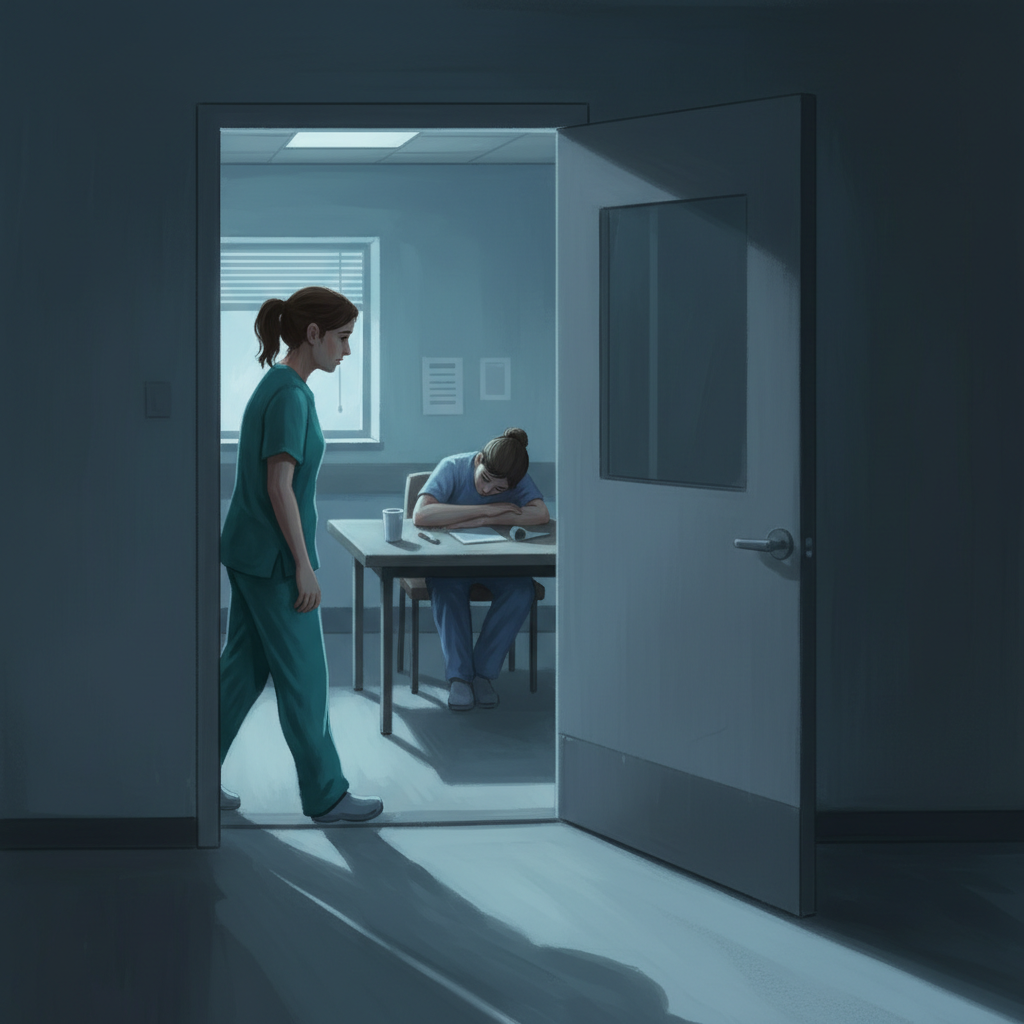
I work night shift on a 40-resident unit. My partner CNA has been falling asleep on the job, like literally in the break room with the door closed, for the last few weeks. I'm answering call lights for both of our assignments. When I bring it up to the charge nurse she says "just go wake her up." But then the next night, same thing. I'm exhausted. I'm scared I'm going to miss something. What do I actually do?
This one shows up a lot in CNAs-only and nursing subreddits. It's not just an annoyance — it's a licensure risk for you, a safety risk for your residents, and a documentation issue that can come back to bite everyone involved. Here's what the experienced CNAs in the comments tend to suggest.
Why this isn't just "wake her up"
The instinct is to treat it as a personal problem — your coworker is tired, give her a nudge, problem solved. That's almost never the actual picture. The real situations behind this pattern:
She might be working a second job. Double shifts are common in this field. Some facilities quietly look the other way because filling the schedule is harder than losing a body. That doesn't make it your problem to absorb.
She might be using substances. Alcohol, marijuana, stimulants that crash overnight, prescription sleep aids. You can't diagnose that, but you can name what you're seeing.
She might be in a mental health crisis. Burnout, depression, a sick kid at home, an unsafe living situation. The sleeping is a symptom.
She might be doing it on purpose because she knows she can. Some CNAs have figured out that if the partner is a hard worker, they can coast. That's the cynical read, but it happens.
She might be a new CNA who genuinely can't stay awake. Night shift is brutal, and some people can't acclimate.
The reason the distinction matters: "wake her up" treats the symptom. What you need is the cycle to stop, because right now you are functionally working 20 residents alone on a unit that requires two CNAs. That's not sustainable and it's not safe.
What you actually do tonight
You cannot fix her behavior. You can only fix yours. Tonight, with the residents in front of you:
1. Prioritize ruthlessly. Both of your call light queues are landing on your hip. You cannot do it all. Answer lights in this order: toileting, pain, falls risk, repositioning (q2h turns), then everything else. Baths, showers, paperwork, nail care — those wait. A resident who waits 20 minutes for a glass of water is fine. A resident who waits 20 minutes for the bathroom is not.
2. Tell the charge nurse in writing. Not in the hallway, not "by the way." Send a text, an email, a written note, or use whatever your facility's incident reporting system uses. "Resident care delayed due to partner CNA unavailable from [time] to [time]. I was sole CNA on unit. Call lights averaged X minutes response time." The medium matters more than the words. If it's not in writing, it didn't happen.
3. Do NOT document that your partner was asleep. That's a clinical/HR judgment and it's not yours to make in the chart. Document what you observed in your own words: "partner CNA not visible on unit during rounds," "partner CNA in break room with door closed during required q2h repositioning round," etc. Stick to facts. Let the charge nurse and DON decide what it means.
4. Wake her up once. Then document that you did. The next time, you don't wake her — you call the charge nurse again. The third time, you're escalating up the chain, not sideways.
What you do tomorrow
The single-shift moves above are survival. They don't fix anything. To fix it, you have to go up the chain, and you have to be willing to be "that CNA" for a couple of weeks.
Step 1: Direct conversation. Yes, it's awkward. Yes, she might hate you. But before you go to management, talk to her. "Hey, I noticed you've been really tired at night. Is everything okay? Are you getting enough sleep?" Give her one chance to be a human about it. Sometimes the answer is "my dad just got diagnosed with cancer and I haven't slept in three weeks" and the problem resolves itself. Sometimes the answer is "yeah I just can't stay up" and you've put her on notice that you noticed.
Step 2: Charge nurse, in writing, with specifics. "On [dates], my partner was unavailable on the unit during [time windows], which left me as sole CNA for 20+ residents. I am concerned about resident safety and my own. What is the facility's plan?" This isn't tattling. This is documenting a patient safety issue, which is literally your scope.
Step 3: DON or unit manager. If the charge nurse is part of the problem — common, because charge nurses are often stretched too thin to do anything about it — go up one more level. Bring your written log.
Step 4: State survey / compliance hotline. Every state has one. If your facility is actively dangerous and management is ignoring it, this is the nuclear option and it is legal. You cannot be retaliated against for reporting a patient safety concern to the state. (Retaliation happens anyway, but it's documented and it's a separate complaint.)
What you do NOT do
This part matters as much as the rest.
Do NOT cover for her by lying in the chart. "Both CNAs performed q2h turns" when you did them alone is falsification. It puts your license on the line for her convenience.
Do NOT stay silent and just absorb it. The first time you let it slide is the time you set the pattern. Six months from now you'll be burned out and bitter and your residents will have been under-cared for the entire time.
Do NOT confront her in front of residents or other staff. If you're going to have the direct conversation, do it off the floor, in private.
Do NOT threaten to quit as a strategy. It sometimes works once. It also sometimes results in you being shown the door.
Do NOT take it home emotionally. You're not her mother. You're not her supervisor. You're a CNA who deserves a partner who's awake.
How to protect yourself on the days nothing changes
Until this resolves — and resolutions in this field can take weeks — build your own paper trail.
- Keep a small notebook in your pocket. Date, time, partner location, what you had to cover.
- Email yourself after each shift with a one-paragraph summary. Timestamped, off the facility network, hard to dispute.
- Save copies of your assignment sheets showing the partner was supposed to be there.
- Photograph the assignment board if your facility uses one. (Check facility policy first — most are fine with this for your own records.)
If a state surveyor ever asks you why a turn was missed or a call light was unanswered, "my partner was asleep" is not a defense. "My partner was asleep, I documented it on these dates, I escalated to these people on these dates, here is my email log" is.
The hard truth
Some facilities know a CNA is sleeping and keep them anyway because replacing them is harder than letting it happen. When that's the case, you are working at a facility that has chosen to understaff you, and no amount of personal effort fixes an institutional problem.
You have three real options in that scenario: escalate to state (slow, sometimes effective), transfer to another unit (fast, sometimes effective), or leave (always effective, sometimes painful). None of them are easy. All of them are legitimate.
You are not a bad CNA for having a partner who doesn't pull their weight. You are a good CNA because you're asking the question instead of silently letting residents go without care.
For more on what you can — and can't — be held responsible for as a CNA, the ExamReady CNA /exam prep covers scope-of-practice scenarios like this one in the practice question bank.
If this kind of post is useful, the full ExamReady library has 1,500+ practice questions, clinical skills with critical-step tracking, and an AI tutor that explains every answer — the same scope-and-voice approach as these posts, with the actual exam tools attached. A 7-day free trial gets you the whole thing, no card required.