Resident has a new skin tear or bruise: did you cause it, and what do you do?
You walk in for your shift and the resident has a skin tear you didn't see yesterday. Family is asking questions. The nurse is asking questions. Here's what to do in the first ten minutes, and how to document so you and the resident are protected.
A CNA on r/cna posted this:
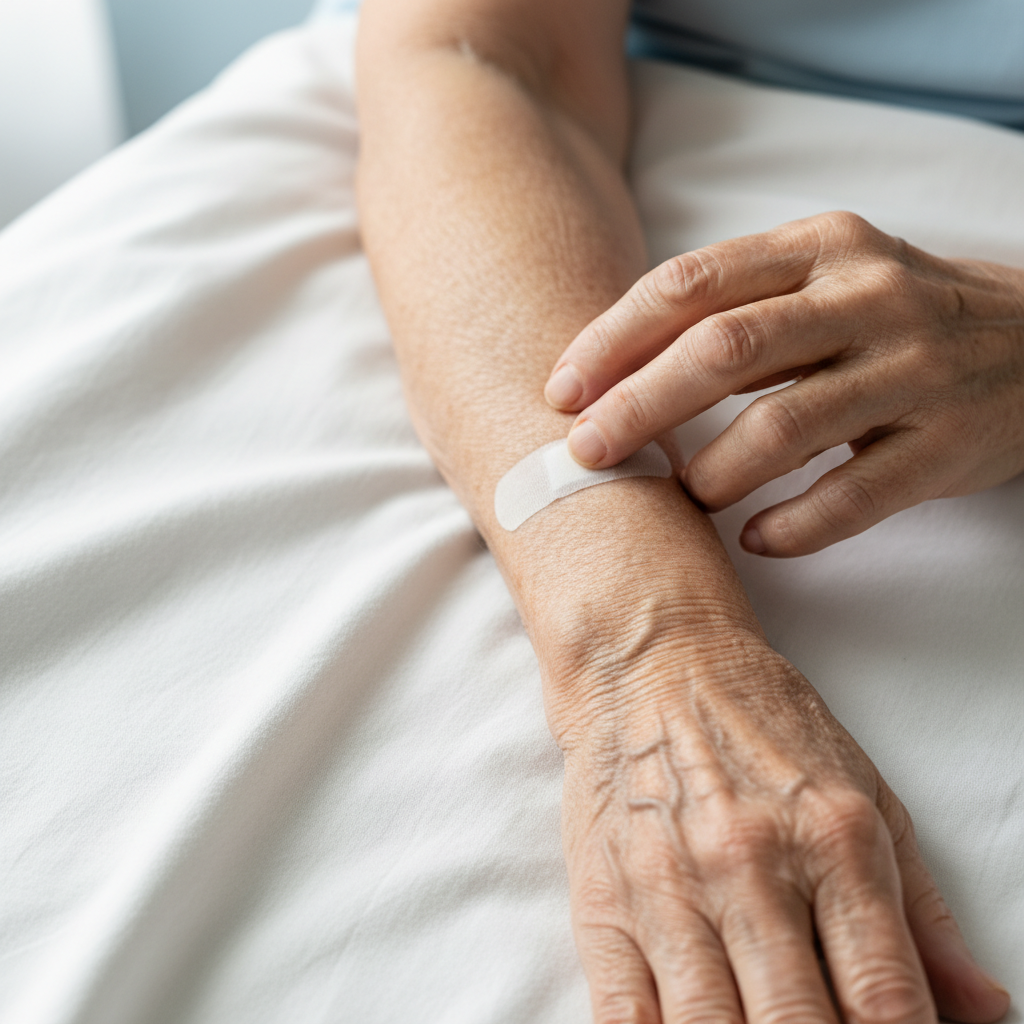
I came in for my evening shift and one of my residents has this bruise on her forearm that wasn't there yesterday. It's about the size of a quarter, kind of purple-yellow. Nobody on the day shift mentioned anything. The family is coming in tonight and they're going to notice. I'm freaking out because I transferred her yesterday morning by myself and I'm worried I did something wrong. The nurse said "just document it" but I don't even know what to write. Has anyone been through this?
This post got 412 upvotes and 156 comments. It's one of those moments almost every CNA has had — the moment you find a new skin tear or bruise and your stomach drops. Here's what's actually going on and what to do in the next ten minutes.
First: take a breath
A new skin tear or bruise on a resident does not automatically mean you or anyone else did something wrong. Skin in elderly patients is genuinely fragile. A small skin tear can come from:
- The resident bumping their arm on the bed rail during a turn, or transferring themselves to the bathroom without telling anyone
- A piece of equipment (BP cuff, watch, bracelet) catching the skin during care
- Anticoagulant medications making any bump look much worse than it should
- Fragile skin in general — elderly skin tears from contact that wouldn't register in a younger person
A bruise can take 12-24 hours to fully appear. If you transferred the resident yesterday morning and you're seeing the bruise now, it might not be from the transfer at all.
Your job right now isn't to figure out the cause. Your job is to report, document, and protect the resident.
The first ten minutes
When you find a new skin tear or bruise, do these things in this order.
1. Make sure the resident is safe and not in pain. Check that the area isn't actively bleeding. Ask the resident if they hurt and if they know what happened. Don't ask leading questions — don't say "did you bump this?" Say "do you know where this came from?" or "does this hurt when I touch near it?"
2. Tell the nurse right away. Don't wait until end-of-shift. Don't try to figure it out first. Walk up to the nurse, in person, and say "I found a new skin tear on Mrs. X's left forearm. She's alert, not in pain, doesn't recall bumping it. I haven't touched it. What do you want me to do?"
The nurse needs to clinically assess it — some skin issues are signs of underlying problems (bleeding disorders, falls, abuse) that require medical follow-up. You also want a witness that you reported it promptly.
3. Don't clean it, dress it, or move it. Your instinct is to fix it. Don't. Let the nurse see it as you found it. If it's actively bleeding, apply gentle pressure with a clean gauze and tell the nurse what you did.
4. Check the rest of the resident. If there's a skin tear on the arm, look at the other arm, the legs, the back, the heels. Pressure injuries and bruises can show up in multiple places, and the full picture matters for the assessment.
5. Check the environment. Was there something the resident could have hit? A bed rail gap, a wheelchair armrest, a tray table corner? Note it. This isn't to assign blame — it's to prevent the next one.
What to document
The nurse said "just document it." That's correct but not specific enough. Here's what actually goes in the chart.
Objective facts only:
- Location (left forearm, 3 inches below the elbow, on the outer side)
- Size (approximate — "quarter-sized," "2 cm x 3 cm")
- Color (purple, yellow, red, dark brown)
- Type of skin issue (skin tear, bruise, abrasion, rash — use the word that matches what you see)
- Whether the skin is intact or open, any drainage, bleeding, or odor
- What the resident said when you asked them
- What the nurse said when you reported it, and what they told you to do
- Time you found it and time you reported it
What NOT to write:
- "I don't know how this happened" (true but unhelpful — stick to facts)
- "This wasn't there yesterday" (only if you personally saw the resident yesterday)
- "Probably happened during transfer" (you're not the assessor)
- Anything blaming yourself, another CNA, the resident, or the family
The rule: if it's not something you directly saw or were told, don't write it as fact. Use phrases like "resident reports" or "no known injury observed."
When it gets harder
A few scenarios worth thinking about in advance:
The family asks you directly. "Did you do this to my mother?" Stay calm. "I don't know how it happened. I found it when I came on shift. I reported it to the nurse, who is assessing it now." Don't guess. Don't apologize for something you don't know you did. Don't get defensive. If the family pushes, refer them to the charge nurse or the DON.
The nurse seems dismissive. Sometimes "just document it" is the right answer. Sometimes it's a nurse who's overwhelmed and doesn't want to deal with paperwork. If you genuinely think the bruise is significant — it's large, there's a pattern of bruises, the resident seems withdrawn or scared, or the resident has cognitive impairment and can't self-report — escalate to the charge nurse. You can do this politely: "I wanted to make sure this got a full look since I haven't seen this kind of mark before. Could you or someone else take a look when you have a minute?"
You genuinely don't know if you caused it. This is the worst feeling. The honest answer is: you may never know, and that's okay. Your documentation and prompt reporting are what matter. If it turns out the bruise is from a transfer you did, your prompt reporting actually protects you — it shows you noticed, you cared, and you escalated appropriately. Hiding it or hoping it goes away is what gets CNAs in trouble. Reporting it is what protects the resident and your license.
The resident has bruises in multiple places, especially in unusual locations. Bruises on forearms, shins, and hips are common in elderly patients who transfer themselves. Bruises on the inner arms, the back, the buttocks, the neck, or in a pattern that looks like fingerprints are different. If you see something that doesn't add up, report it to the nurse AND, depending on your facility's policy, to social services or the DON. You are a mandated reporter. This is one of those moments where speaking up, even if you're not sure, is the right call.
What "good documentation" actually does
When you document a new skin tear or bruise well, you are doing three things at once.
You are protecting the resident. A clear, objective note becomes part of the care plan. If the resident is on blood thinners, falls risk, or has a pattern of skin issues, your note helps the team adjust the care plan — maybe a different transfer technique, a skin-protective dressing, or a medication review.
You are protecting yourself. If a family later complains, or if the bruise turns out to be a pressure injury that developed over days, your documentation shows that you found it promptly, reported it to the nurse, and documented it accurately. That is exactly what your facility's risk management team and your state board want to see.
You are helping the next shift. The CNA coming on after you will read your note and know what's there. That continuity is how good care works — not one CNA being perfect, but every CNA doing the next honest thing.
The hard truth
You will, at some point in your career, cause a skin tear. Not because you're careless — elderly skin is fragile, and transfers and turns and repositioning involve contact, and sometimes contact causes damage. When it happens, the path forward is the same: notice, report, document, learn what you can, adjust your technique if there's a clear adjustment to make, and keep going.
The CNAs who get into trouble aren't the ones who cause skin tears. They're the ones who hide them, document around them, hope nobody notices. The CNAs who last in this work are the ones who write down what they saw, tell the nurse, and move to the next resident.
You're not failing because a resident has a bruise. You're failing only if you don't report it.
If this kind of post is useful, the full ExamReady library has 1,500+ practice questions, clinical skills with critical-step tracking, and an AI tutor that explains every answer — the same scope-and-voice approach as these posts, with the actual exam tools attached. A 7-day free trial gets you the whole thing, no card required.