Resident found on the floor: what to do before, during, and after the fall
You walk into a room and your resident is on the floor. The exact steps to take in the first 60 seconds, what to document, and how to protect yourself if the family asks why it happened.
A CNA on r/cna posted this:
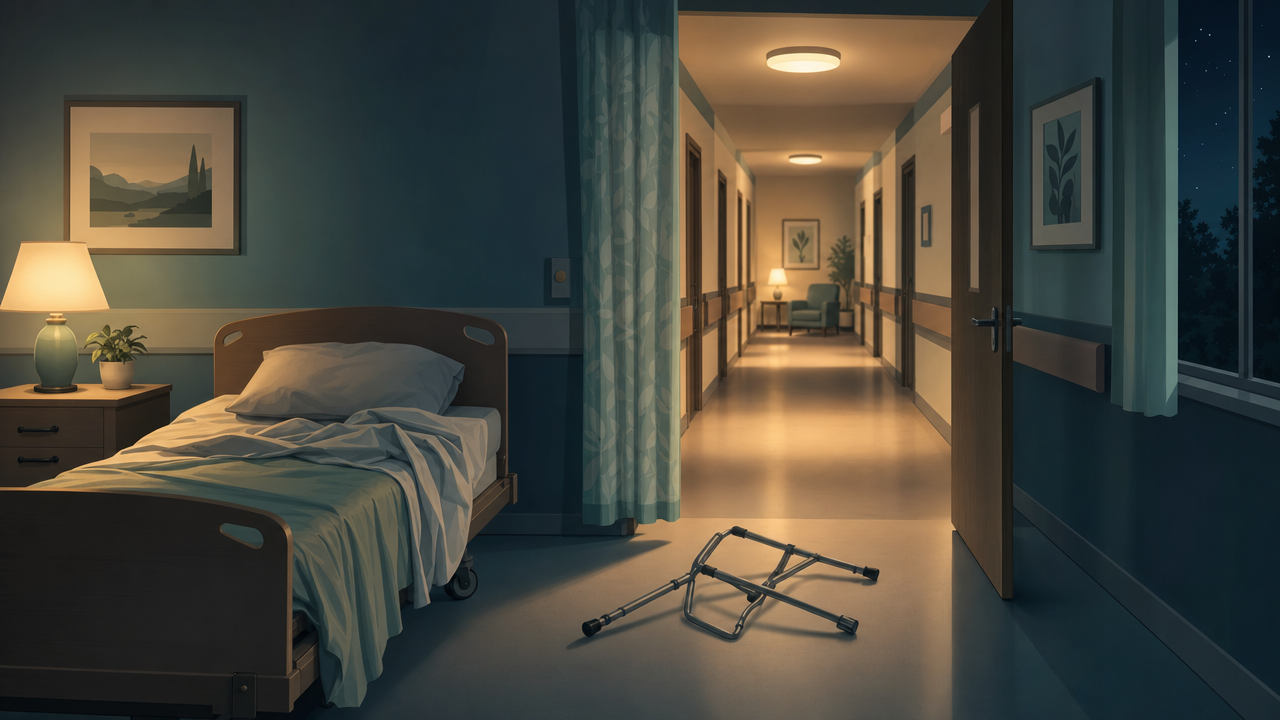
I walked into Mr. H's room for his 2 a.m. incontinence round and he was on the floor next to his bed. He was awake, said he was fine, said he slid trying to grab his water cup. I helped him up and back to bed, took his vitals, and told the nurse on the way out. She asked if I filled out a fall incident report and I said no, I didn't think he actually fell, just slid. She said it didn't matter, I still needed to document it. By the time I got home I was freaking out — am I in trouble? Was I supposed to do something different when I found him? What if he hit his head and I didn't know?
This is one of the highest-anxiety moments in CNA work. Most of us will walk into a room and find a resident on the floor at some point in our career. The steps you take in the first minute, the rest of the shift, and the next day all matter — for the resident's safety and for yours.
Before you do anything: stop at the door
The first instinct is to rush in and help the resident up. Don't. Stand in the doorway for about five seconds and look.
You're doing three things in those five seconds:
- Scanning for new hazards. Water, urine, a spilled drink — anything that made the fall more likely to happen again if you step in.
- Looking at the resident's position. Are they twisted, sitting up, lying flat, wedged between the bed and the wall? Where did they land?
- Looking at their face. Awake, alert, confused, drowsy, pale, sweating, bleeding? You need a baseline before you touch them so you can report changes.
If you walked in and immediately grabbed the resident to lift them, you lose information. You also might miss that they hit their head and are now altered.
The first 60 seconds
Once you've scanned, go in and stay calm. Talk to the resident the whole time, even if they seem out of it.
- Do not move them yet. Ask: are you hurt? Where does it hurt? Can you move your arms and legs? Did you hit your head? — ask even with no obvious injury. A lot of head injuries in elderly residents don't show up immediately.
- Call for help. Hit the call light, ask the roommate to press theirs, yell down the hall, or use your facility phone. You need a second person: a witness and a second set of hands if the resident can't bear weight.
- Take vitals if you can without moving them. Pulse, respirations, level of consciousness. If you have a pulse ox, use it.
- Look at the resident's pupils. Equal, round, reactive to light? Unequal pupils after a fall are a red flag — get the nurse immediately.
Order matters: assess, call for help, then act. Most CNAs skip straight to "help them up." That order can hide an injury and can get you in trouble if anything goes wrong.
Helping them up
If the resident is alert, denies hitting their head, can move all extremities, and wants to get up, you still need help. Do not lift a fallen resident by yourself. Even small older adults can be deceptively heavy when they're not bearing weight, and you put both of you at risk.
The standard approach:
- Bring a second staff member in.
- Use a gait belt if your facility requires it (most do).
- If the resident cannot bear weight, the nurse needs to evaluate before you attempt to lift. Some facilities have mechanical lifts; some want EMS called for a non-injury lift assist. Know your facility's policy.
- Get the resident back to bed, take vitals again, do a head-to-toe check.
Document any skin tears, bruises, swelling, or pain the resident reports. A bruise that looks minor today could matter in two weeks if they end up in the hospital. Your documentation from today is what the team will look at.
The fall incident report
The nurse was right: a resident on the floor is a fall, even if they "just slid." If the resident ended up on a surface lower than where they started, it counts. The exact definition varies by facility, but the practical rule is: if they touched the floor and weren't supposed to, it's a fall.
You will likely need to fill out some version of:
- Time you found the resident
- Time the fall is estimated to have happened (your best guess)
- Where the resident was and what they were doing
- What they told you happened
- Your assessment (vitals, mental status, injuries)
- Any witnesses
- What you did
This is not the place to minimize. Don't write "resident slid onto floor." Write "resident found on floor next to bed, states he reached for water cup and lost balance." Don't write "no injuries noted." Write "no visible injuries, denies pain, full ROM in all extremities, vitals stable."
The documentation gets reviewed by the nurse, the DON, often the medical director, and sometimes the family. Vague documentation makes everyone nervous. Concrete documentation protects everyone.
What to do for the rest of the shift
After a fall, the resident needs closer observation. Most facilities require neuro checks every 15 minutes for the first hour, then every 30 minutes for a few hours, then every hour. Neuro checks mean: are they alert and oriented, can they speak normally, are their pupils equal, can they move all four extremities on command.
You also need to make sure the call light is within reach, put the bed alarm back on (and ask why it didn't work if it was already on), and reassess their toileting schedule — a lot of falls are "I was trying to get to the bathroom."
If you don't know your facility's post-fall protocol, ask your charge nurse today, before anyone falls. Protocols vary a lot between facilities, and you don't want to learn yours during one.
The conversation with the family
When the family calls — and they will, often that same day — the nurse usually talks to them, but you might be asked to clarify what you saw. Stick to facts: time you found the resident, what they told you, what you observed, what you did.
Do not speculate. Don't say "this is the third time he's fallen this month" even if it's true. Don't say "I think he was trying to get up on his own." If a question is outside what you observed, defer to the nurse.
What NOT to do
A few things that come up constantly in r/cna comments:
- Don't lift the resident alone. Even if they're tiny. Even if they say they're fine. Get help.
- Don't skip the incident report because it seems minor. The bruise that looks minor today is the hip fracture next month. Document.
- Don't move them before assessing. Head injuries, hip fractures, and spinal injuries can all be made worse by moving someone before you know what happened.
- Don't tell the resident "you shouldn't have tried to get up alone." They know. Lecturing them increases anxiety and makes future falls more likely, not less.
The hardest part: protecting yourself
The CNA in the original post was worried about being in trouble. The honest answer is: if you followed the steps — assess, call for help, don't move them alone, take vitals, document, report to the nurse — you did your job. A fall is not, by itself, evidence of neglect. Falls happen in well-staffed facilities with great CNAs. The system has to be designed to prevent them.
What gets CNAs in trouble is not the fall — it's the gap between the fall and the documentation. A resident found on the floor with no incident report, no neuro checks, and no nurse notification is a problem. A resident found on the floor with a complete report, a nurse notified within minutes, and neuro checks documented on time is a facility problem, not a CNA problem.
If your facility is short-staffed to the point where you can't do post-fall neuro checks on every resident, that's a staffing problem. Document it. Bring it up. Protect yourself on paper even when you can't protect yourself on the floor.
You're going to walk into a room and find a resident on the floor eventually. The work you put in now — knowing the protocol, knowing your role, knowing what to document — is what makes that moment survivable for both of you.
The ExamReady CNA skills review covers fall response, post-fall assessment, and incident reporting as part of the clinical checklist — the kind of step-by-step practice that makes the first time less scary than the CNA in this post experienced.
If this kind of post is useful, the full ExamReady library has 1,500+ practice questions, clinical skills with critical-step tracking, and an AI tutor that explains every answer — the same scope-and-voice approach as these posts, with the actual exam tools attached. A 7-day free trial gets you the whole thing, no card required.