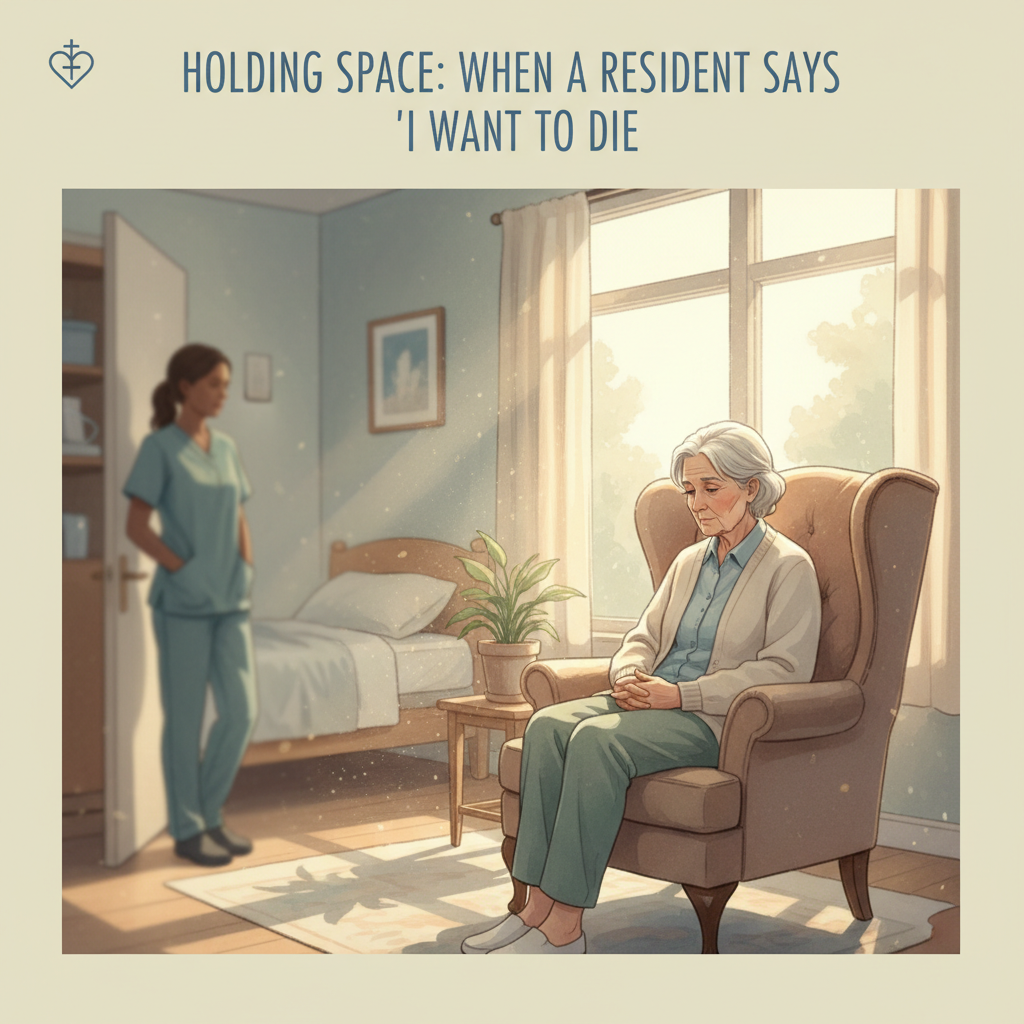
Resident says 'I want to die': what to say and what not to say
A real r/cna scenario about a long-term resident who tells you they want to die. What you're allowed to say back, what you must report, and what helps in the moment without crossing your scope.
A CNA on r/cna posted this:
Had a resident today say to me, completely out of nowhere, "I just want to die already." She wasn't crying, she wasn't angry, she just said it like she was telling me the weather. I didn't know what to say. I ended up just going "oh, okay" and changing the subject and walking out. I've been thinking about it all night. Was that wrong? Should I have said something? Who am I even supposed to tell about this?
This kind of moment lands on almost every CNA at some point. It's also one of the most commonly mishandled moments in long-term care. Here's what's actually going on, what your scope allows, and what helps in the moment.
What you're actually hearing
"I want to die" from a long-term or post-acute resident is usually one of four things, and they need very different responses:
1. A grief statement, not a plan. The resident is mourning their old life, their independence, their body, or their future. The statement is true — they do feel that way in this moment — but there's no plan, no means, no intent to act. It's the emotional equivalent of saying "I'm so tired of this."
2. Unmanaged pain, depression, or a medical issue. New or worsening depression, an undertreated UTI, a missed dose of an antidepressant, post-stroke apathy, a sudden change in a chronic condition. The statement is a symptom. Fix the symptom and the statement goes away.
3. A genuine cry for help. The resident is telling you because you're the person who walks in the door. They may not have told the nurse, the doctor, or their family. You are the disclosure.
4. Cognitive impairment speaking. For residents with advanced dementia, the statement may have no coherent meaning attached. It needs to be reported because something is changing in their brain or body, but it's not a suicidal communication in the usual sense.
You can't always tell which one you're hearing in the moment. That's not your job. Your job is to take it seriously, not to diagnose it.
What to do in the moment
The instinct to "go 'oh, okay' and change the subject" is the most common response, and it's understandable — it comes from a place of not knowing what you're allowed to say. But it leaves the resident alone with the feeling, and it skips the only piece of scope you actually control.
Stop what you're doing. You don't have to sit down. You don't have to drop everything. But stop rushing. Turn toward them. Make eye contact if culturally appropriate.
Acknowledge what they said. Not by agreeing, and not by minimizing. Something like: "I hear you. That sounds really heavy." or "Thank you for telling me that. I'm going to make sure the right people know." That's it. You don't have to fix the feeling.
Don't argue them out of it. "Oh, you don't mean that" or "you have so much to live for" almost always makes the resident shut down. It tells them you don't want to hear it, so they stop telling anyone.
Don't promise you can fix it. "I'll make sure you feel better" is a promise you can't keep. Stay in scope. "I'm going to tell the nurse, and I'm going to stay with you until she gets here" is something you can actually do.
Don't promise confidentiality. A lot of CNAs hesitate to tell anyone because they don't want to "break the resident's trust." You don't have a confidentiality relationship with a resident like a therapist does. Anything that touches safety is reportable. The nurse needs to know.
Stay physically present and unhurried for a few minutes. If you can sit down, even for ninety seconds, that does more than almost anything you could say.
Who you tell
You tell the nurse. Immediately. Same shift, before you leave the floor, before lunch, before anything else. If it's end of shift and you're going home, tell the oncoming CNA and the charge nurse before you walk out.
You don't wait to "see if it happens again." One statement is enough. The nurse decides what happens next — assessment, provider notification, depression screening, family call, 1:1 sitter, change in care plan. None of that is your call. All of it depends on you saying the words out loud.
If the resident has a plan, a means, or a timeline, you tell the nurse right now and you don't leave the room until someone else is there. If the statement is acute and you're alone on the floor, use the call light, use the phone, page overhead — escalate by whatever your facility's protocol allows.
What you document
In your narrative note, stick to what was said and what you did. Not what you thought they meant, not how it made you feel. Example:
Resident stated, "I just want to die already," while being repositioned at 14:20. No apparent distress or plan stated. Resident denied intent when asked. Verbalized understanding that nurse was being notified. RN [name] notified at 14:22 and came to room. Resident continued to deny suicidal ideation to RN. Will continue to monitor and report any further statements.
That note does four things: it records the statement exactly, it shows you asked the follow-up question, it shows who you told and when, and it shows you kept monitoring. If the statement ever escalates — if the resident says it again tomorrow, or mentions a plan, or someone else reports something — your note is the start of the timeline.
What you don't do
Don't ignore it. The "oh, okay, change the subject" response is the most common mistake. It comes from a kind place — you don't want to make it worse — but it does. It tells the resident their statement wasn't worth hearing, and it skips the mandatory report.
Don't try to counsel them. You are not their therapist, their chaplain, or their family. Therapeutic communication at the CNA level is acknowledgment, presence, and honesty. It is not solving.
Don't tell other CNAs at report as gossip. "Mrs. Jones in 214 said she wants to die today" is not report material in the breakroom. It is report material to the oncoming nurse, in the chart, and to the care team. There is a difference between handoff and gossip.
Don't tell the family unless you're directed to. That's the nurse's call after the provider has been looped in.
Don't promise you'll keep it between you. Even if you mean well, it's a promise you can't keep, and it isolates the resident from the help they need.
Don't take it home with you alone. If a resident's statement sits in your chest for the rest of the shift, talk to someone. A trusted CNA, the charge nurse, your facility's employee assistance line, a friend outside work. You are not the resident's only support. You can't be.
The hard truth
Some residents will say this more than once. Some residents will say it every shift. Some of them will mean it more the second time than the first. None of that changes your response. Acknowledge, report, document, stay present. Every time.
You're not going to talk someone out of wanting to die. That's not in your scope and it was never going to be. What you can do — what matters — is make sure the statement is heard by the people who can actually act on it, and that the resident isn't alone with it in the ten minutes between when they say it and when the nurse walks in.
That is enough. It's a lot, actually.
If this kind of post is useful, the full ExamReady library has 1,500+ practice questions, clinical skills with critical-step tracking, and an AI tutor that explains every answer — the same scope-and-voice approach as these posts, with the actual exam tools attached. A 7-day free trial gets you the whole thing, no card required.