Resident sundowning: how to handle late-day confusion and agitation
A real r/cna question about a dementia resident who becomes confused, agitated, and sometimes combative every evening starting around 4pm. What's actually happening, and what CNAs can do to get through it.
A CNA on r/cna posted this:
I've been a CNA for about 8 months and most days I can handle things fine, but there's one resident who every single day around 4pm just completely changes. She's sweet as pie in the morning — will laugh at my jokes, knows my name, helps me fold towels. Then right around dinner shift change she gets really agitated, starts accusing me of stealing her purse, tells me her mother is in the waiting room (her mother has been dead 30 years), and yesterday she tried to hit me when I tried to redirect her to her room. I know it's not her fault, but I don't really know what I'm supposed to do differently and the other aides just kind of shrug when I ask. This happens every single day.
This is one of the most-searched dementia topics in long-term care, and almost every CNA runs into it. Here's what's actually happening and what helps.
What sundowning is
Sundowning isn't a diagnosis — it's a pattern. Residents with dementia (most often Alzheimer's, but it shows up in vascular dementia and Lewy body too) become more confused, anxious, disoriented, and sometimes aggressive in the late afternoon and evening. The pattern is so common it has its own name.
It usually starts sometime between 3pm and 5pm and can run until the resident falls asleep. Some facilities see it as a near-daily thing. It often gets worse mid-stage and improves again in late-stage, though that's not a hard rule.
Why it happens
There's no single cause, but a few things feed into it:
Fatigue. After a full day of input — meals, bathing, therapy, family visits, hallway noise — the brain has less left to manage. Confusion rises.
Low light. Around the time the sun goes down, shadows shift. A resident who navigates by memory can't tell whether that shadow is a coat rack or a person, and the brain fills in something threatening.
Circadian rhythm disruption. Dementia damages the part of the brain that regulates sleep-wake cycles. The body's "evening" signal comes too early or too strongly.
End-of-day staffing. Shift change is loud. Call lights are stacking up. The energy in the building is rushed. Residents feel that.
Unmet needs. Pain, hunger, a full bladder, constipation — these all get harder for a confused resident to articulate at the end of the day, so the underlying need shows up as agitation.
Overstimulation earlier in the day. A resident who had a busy morning — a big family visit, a long therapy session — often sundowns harder.
What the resident is experiencing
This part is worth sitting with. Around 4pm, the resident's brain is telling them something is wrong. The walls don't quite look right. The CNA doesn't look familiar. The purse should be here and it isn't. The mother was supposed to pick them up — where is she?
From inside the resident's experience, the agitation makes sense. They're not being difficult. They're scared, and they don't have the words for it.
That doesn't mean you have to take a hit. It does mean the goal isn't to "convince" them they're wrong. That's not going to happen.
What tends to work
1. Reduce stimulation, don't add to it.
A loud TV, a hallway with three staff members shouting across each other, a roommate's family visit going past 5pm — these all amplify sundowning. The opposite helps: dim lights early, close the curtains before the sun gets low, move the resident somewhere quieter if you can.
2. Match their reality.
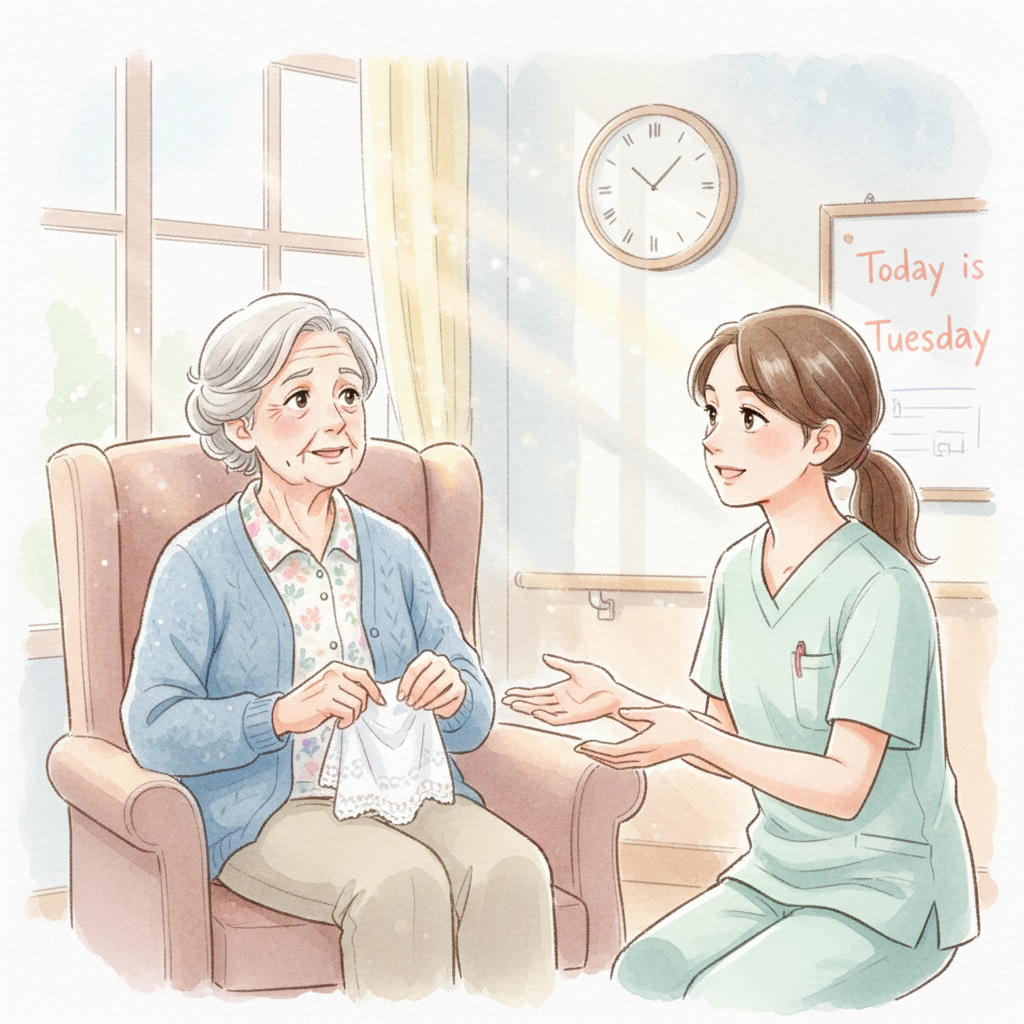
If she's asking for her mother, don't say "your mother has been dead for 30 years." She doesn't have access to that fact right now. She's also going to experience "your mother is dead" as a fresh grief every time you say it. Instead: "Tell me about your mother. What was she like?" Or, if she insists her mother is in the waiting room: "Let's walk to the lobby together and check." When you get there, she'll usually re-orient, and you redirect naturally.
3. Keep the routine identical.
The residents who sundown hardest are often the ones whose day has been unpredictable. Same breakfast time. Same chair. Same CNA when possible. Same order of tasks. Routine is what the failing brain can still lean on.
4. Address the basics before it starts.
Around 3pm, before the pattern kicks in: offer a snack, offer the bathroom, offer pain meds if they're scheduled PRN and you can ask the nurse. Sundowning that was really "I'm hungry and my hip hurts" looks a lot like sundowning that was really sundowning.
5. Light and movement earlier in the day.
Natural light exposure in the morning and physical activity during the day — even a walk down the hall — reduce sundowning severity. The residents who sit in their rooms all morning, dozing under fluorescent lights, sundown hardest.
6. Validate, don't argue.
The instinct is to correct. The reality is that correction escalates. "Your purse is right here, I put it in the drawer" feels reasonable; to the resident, it sounds like "you don't remember where you put your own things, you're confused, something is wrong." Lead with agreement and gentle redirection.
What NOT to do
- Don't restrain or corner them. A sundowning resident who feels trapped escalates fast, and physical contact is one of the top triggers for hitting or grabbing.
- Don't raise your voice. It reads as a threat.
- Don't try to reason them out of the delusion. They're not reasoning. They're experiencing.
- Don't take it personally. The resident who accuses you of stealing doesn't believe that. The brain is filling gaps with whatever pattern fits.
- Don't rush. The single biggest mistake is speed. A hurried handover, a fast bath, a quick "let's go, let's go" — sundowning residents respond to the feeling of being rushed as if they're in danger.
What to do when it escalates anyway
Sometimes nothing you do prevents the agitation. The resident gets loud, accusatory, sometimes physically aggressive. At that point:
- Step back. Give two arms' lengths of space. Make sure you have an exit path.
- Lower your voice, not raise it.
- Simplify. One short sentence at a time. "I'm here. You're safe. Let's sit."
- Call for help before it becomes a crisis, not after. Get the nurse in the room.
- If they're a danger to themselves or others, that's a medical event. Document it as such, not as "behavior."
What to document
When sundowning episodes happen, document:
- Time it started and ended
- Specific behaviors (yelling, hitting, wandering, accusations)
- Triggers you noticed (shift change, family visit, missed snack)
- What de-escalation worked
- What made it worse
This becomes the care plan. The charge nurse, the DON, the family, the doctor all need this data. "Resident sundowns every evening" is useful. "Resident becomes agitated around 4pm, accuses staff of stealing, hit CNA once on 8/14, calms when taken to the lobby and given a snack" is the data that changes care.
The piece nobody talks about
Sundowning is exhausting in a way that other parts of CNA work aren't. It's the same fight every day, with someone who doesn't remember yesterday's version of it. You're doing emotional labor on top of physical labor, and the resident isn't going to thank you, because they don't know what you did.
That's normal. It's also the part that burns CNAs out of dementia care fastest. If you're finding this work heavy, you're not failing — you're paying attention. Talk to the charge nurse about assignment rotation if you can. Take your breaks. Take your PTO. The residents who sundown need CNAs who are rested enough to handle it.
The resident in the post I started with — the sweet-as-pie morning version and the 4pm version are the same person. Both deserve your patience. Only one of them knows it.
If sundowning behavior is on your state's CNA exam — and it is on most of them — the questions look a lot like this post. ExamReady's clinical skills section walks through the steps and the rationales the way a study guide should.
If this kind of post is useful, the full ExamReady library has 1,500+ practice questions, clinical skills with critical-step tracking, and an AI tutor that explains every answer — the same scope-and-voice approach as these posts, with the actual exam tools attached. A 7-day free trial gets you the whole thing, no card required.