Clinical skills exam: the 5 critical steps that fail most students
Most NNAAP clinical skills failures aren't the steps you forget — they're the critical steps you forget to *verbalize*. Here's the small habit that fixes it.
The clinical skills exam is where most CNA candidates fail — and it's not for the reason they think.
I worked as a CNA for 8 years before becoming an RN. I've watched hundreds of students go through skills testing. The pattern is consistent: the person who fails isn't the one who forgets to wash their hands. They're the person who washes their hands silently.
What "critical step" actually means
The NNAAP skills checklist marks certain steps as critical. Miss one, and you fail the entire skill, regardless of everything else you did correctly. Common critical steps:
- Hand hygiene before and after every skill
- Identifying the resident before any care
- Explaining the procedure to the resident
- Privacy — closing curtains, knocking before entering
- Safety checks — bed locked in low position, call light in reach
Most of these aren't technical. They're communication and verification steps. The actual physical skill is easy. The verbalization is where candidates drop points.
The verbalization habit
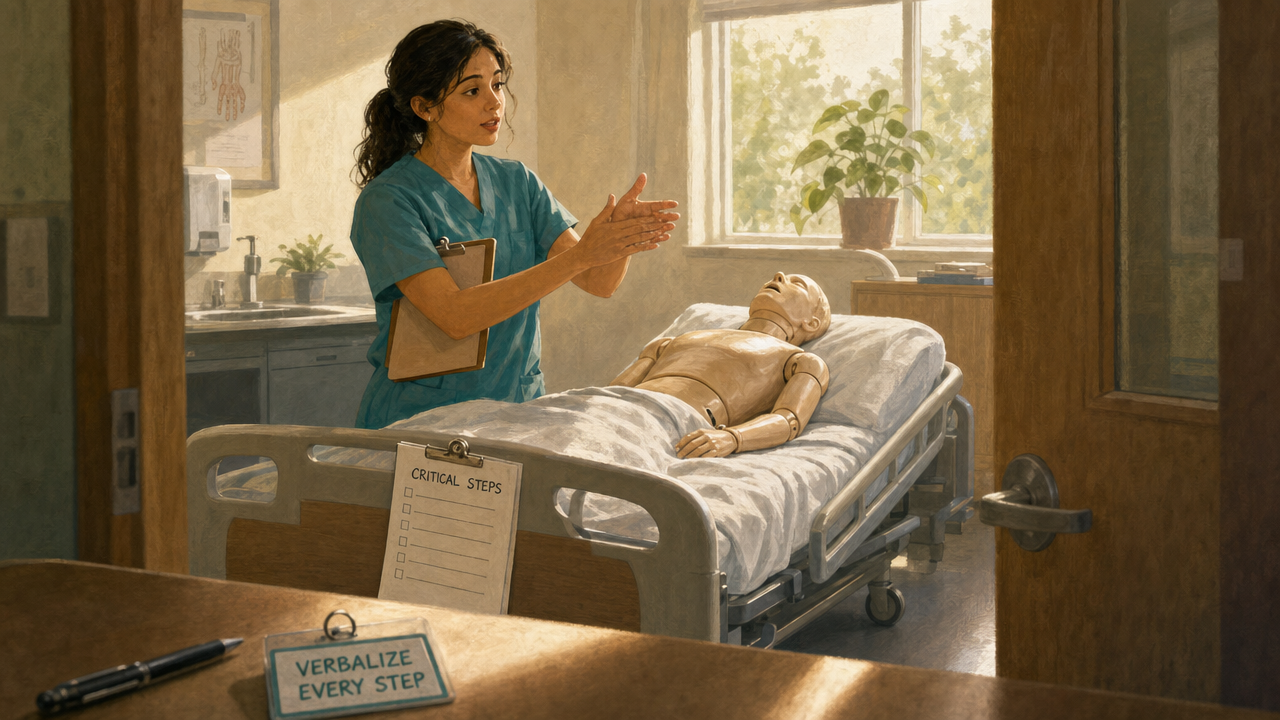
When you practice at home, say every step out loud. Not the obvious physical ones — say the critical ones out loud. Walk through hand hygiene and say:
I'm going to wash my hands now. Turning on the water, testing temperature, applying soap, washing for at least 20 seconds, rinsing, drying with paper towel, using paper towel to turn off the faucet, disposing of paper towel.
That feels silly. Do it anyway. The exam has a time limit but it's not about speed — it's about showing the evaluator you're thinking about the right things. Verbalization is the cheapest way to prove that.
Practice with a checklist, not from memory
The wrong way to practice:
"I'll do hand hygiene" → does hand hygiene → done.
The right way:
- Print or write out the official NNAAP skills checklist for the skill you're practicing
- Walk through it line by line
- Every time you reach a step, read it aloud then do it
- Mark the step off only after you've actually completed it
This is slower. That's the point. The exam isn't testing whether you can wash your hands fast. It's testing whether you'll skip steps when you're nervous.
The most-skipped critical steps
Across hundreds of students I've watched, the critical steps that get skipped most:
- Hand hygiene between residents. Doing it before, but not after. Or after, but not before.
- Calling for help before transfers. Especially the second transfer in a sequence — the candidate does the first one and then tries the second one alone.
- Locking the bed and wheelchair. Locking one but not the other.
- Knocking before entering the room. Even when the door is open. The evaluator watches for the knock.
These aren't hard to do. They're hard to remember to do consistently. The only fix is the verbalization habit.
Where ExamReady helps
Our clinical skills walkthroughs are built directly from the NNAAP checklist. Each step is listed in order, with the critical steps clearly marked. The point of the walkthrough isn't to teach you the technique — it's to make sure you don't skip a step under pressure.
Practicing with a checklist that's structured the same way the evaluator's checklist is structured means you build muscle memory for that specific flow. When exam day comes, the checklist in your head matches the checklist in the evaluator's hand. That's what makes the difference.
If this kind of post is useful, the full ExamReady library has 1,500+ practice questions, clinical skills with critical-step tracking, and an AI tutor that explains every answer — the same scope-and-voice approach as these posts, with the actual exam tools attached. A 7-day free trial gets you the whole thing, no card required.