 ExamReady CNA
CNA state exam skills day: what the evaluator is actually looking for
You know the steps. The question is how the state evaluator scores them — and the small habits that turn a 'passing' skill into a confident one.
A CNA on r/cna posted this:
I take my state skills exam in 9 days. I practiced handwashing at home last night and timed myself and got it done in like 35 seconds. My instructor watched me do peri-care today and said I "forgot two things" but couldn't tell me which two. I'm spiraling. What does the evaluator ACTUALLY look for? Is it the order? Specific words? Time? I'm watching YouTube videos and everyone does the skill slightly differently. How do I know what counts?
The panic in that post is real, and it's specific to the skills exam — because unlike the written test, you can't study for the skills exam by reading facts. You study for it by understanding what the rubric is rewarding. Most candidates don't realize the rubric is rewarding something different than what they think.
What the rubric actually scores
A skills exam rubric (often called a Performance Checklist, Skills Evaluation, or Critical Element Checklist) generally separates the steps you must get right from the rest. The exact scoring differs by state and vendor, so treat the breakdown below as a way to think about it, not an official scoring rule:
1. The critical steps. These are the steps the candidate must perform to pass. Miss one and you do not pass that skill. Examples: locking the wheelchair brakes before transferring, performing hand hygiene, identifying the resident before beginning care. Your state's candidate handbook or vendor lists the steps for each skill.
2. The non-critical steps. These are the other steps on the checklist. Credentia notes that passing a skill also requires enough of the other steps, not just the critical ones, so don't treat them as optional.
3. The "don't do this" list. Evaluators also watch for unsafe actions or missed safety steps, whether or not they appear on the "must do" list. Forgetting to lower the bed before you walk away. Turning your back during a transfer. Talking over the resident instead of to them.
The mistake most candidates make is memorizing the skill as a sequence ("first this, then that, then this"). The evaluator isn't scoring a sequence. The evaluator is scoring a checklist of behaviors and any deviation from the behaviors in the order listed is usually fine — but missing any one of those behaviors is not.
What evaluators notice that candidates don't
Based on what candidates and instructors commonly report, here's what evaluators tend to flag:
The opening. Did you knock? Introduce yourself? Identify the resident by name AND check the wristband? Pull the curtain for privacy? State the skill out loud? The first moments set a tone, and several checklist steps usually come right at the start. Rushing past them is a common way to lose a skill.
The "audibles." Anything you can say to the room that isn't on the script. Calling out step transitions: "I'm going to lock the wheels now." Narrating what you're doing even when no one's watching. It helps the evaluator see that you know what you're doing. Candidates who silently perform each action leave the evaluator guessing.
Hand hygiene. On the NNAAP, hand washing is always one of your five skills, and hand hygiene shows up in other skills too. Most candidates remember it at the start and forget it at the end.
Verbal cues. Did you ask the resident to help you before each transfer? Did you explain the skill before starting? Did you let them know when you were about to touch them? Check your checklist for which of these are required, and do them anyway.
The close. Did you return the call light? Did you make sure the resident was comfortable and safe before you walked away? Did you perform hand hygiene again before touching the door handle? The close is easy to rush, and it is where checklists often include safety steps.
Three habits that separate a shaky skills run from a confident one
1. Wear gloves when you could plausibly need them, take them off when you're done. Candidates lose steps for putting on gloves once and leaving them on through the entire skill — even during the verbal portion when you're not touching the resident. Evaluators want to see you put on gloves before contact and remove them before you leave the bedside. Always.
2. Say the words even if your hands already did the thing. "I'm going to lower the bed now" right as you lower it. "Call light is on the pillow within your reach" right after you set it down. The evaluator can't score what they can't verify. If you do it silently and they happen to look away, you might not get the point.
3. Slow down at the transitions. The transitions between sub-steps are where candidates rush. The transition between peri-care and re-dressing. The transition between the transfer and settling the resident into the chair. The transition between turning the resident and adjusting the pillow. Take one extra breath. The candidate who looks calm tends to run the checklist more cleanly.
What NOT to do during skills day
- Don't argue with the evaluator. If they say you forgot something, you accepted their call. Politely ask for clarification but don't correct them. Most evaluators are RNs who've been doing this for years.
- Don't skip the introduction. Identifying yourself and the resident is on many checklists, and skipping it looks careless.
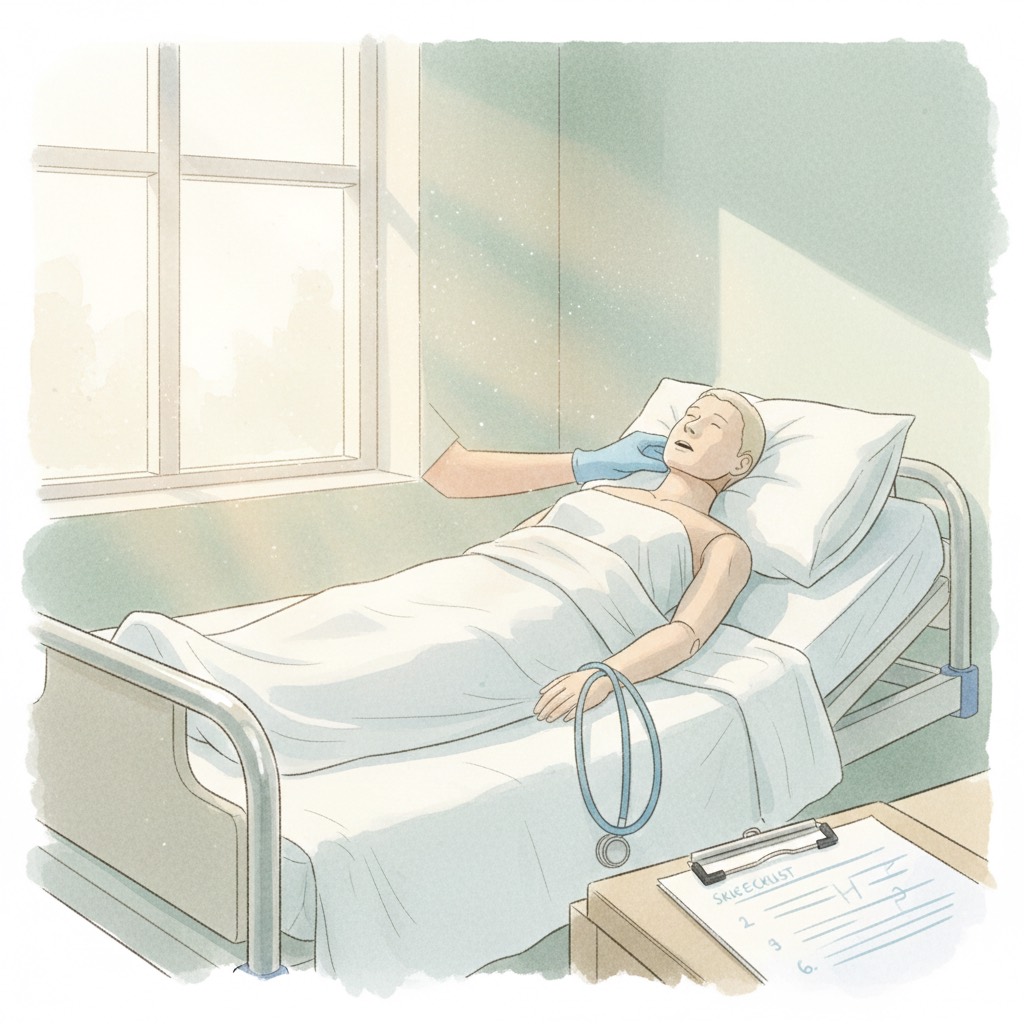
- Don't fudge the mannequin. Depending on the skill, you may work on a mannequin or a live volunteer ("actor"). Treating the mannequin as if it has feelings — talking to it, telling it what you're about to do, asking "are you okay?" — does not look weird. It looks professional.
- Don't make up the skills. If the evaluator gives you a skill you didn't get to in class, tell them calmly you'd like a minute to think through it before starting. Ask the evaluator what is allowed before you begin.
- Don't chat with the actor. Many candidates treat the live volunteer like a friendly patient and start having a conversation. Keep it focused on the skill. Side chatter reads as nervous behavior.
What the written test is actually testing, while we're here
If you're also worried about the written portion, topics worth reviewing include infection control and hand hygiene, resident rights and dignity, communication and reporting, safety and emergency procedures, and basic anatomy. The /skills/[skill-slug] section on ExamReady walks through the skills with critical-step vocabulary, so you don't have to guess which words matter.
If this kind of post is useful, ExamReady CNA has practice questions with kind explanations, clinical skills walkthroughs with critical steps flagged, and a study coach. Start your 7-day free trial. 7 days free, then $9.99/month. Cancel anytime.
A little every day
Practice questions with kind explanations, and 23 clinical skills walkthroughs with critical steps flagged.
Start your 7-day free trial7 days free, then $9.99/month. Cancel anytime.