When a family member asks 'is my mom dying?': what to say
A real r/cna question about a family member cornering a CNA in the hallway asking whether their mother is dying. What's the right answer when the family is asking you, not the nurse?
A CNA on r/cna posted this:
I had a family member grab me in the hallway today and ask me straight up if her mother was dying. Her mom is 89, on hospice, has stopped eating much, sleeps most of the day, and the family member said "no one will tell me the truth." I just froze. I said I wasn't the right person to ask and that the nurse would talk to her, but she got really upset and said the nurse keeps dodging the question. I feel horrible. Was there something better I should have said?
This is one of those moments that catches you off guard every time, even after years on the floor. The hallway, the family member's face, the raw question. Here's what's actually happening and what to say.
Why they corner you and not the nurse
Family members ask CNAs these questions for a reason, and it's not because they think you have medical answers you don't have. It's because:
You're the one who's there. The nurse has 20 residents, charting, meds, the next round. You are the person they see, the person they walk past, the person who answers the call light at 2 a.m. when their mom needs repositioning. You're accessible in a way the nurse isn't.
You were warm. Family members read CNAs as more approachable than nurses or doctors. You're the one who remembers their mom likes her blanket folded a certain way. They're not asking you because they think you know more — they're asking you because they trust you enough to ask.
They've been told "we can't discuss that" too many times. When medical staff keep redirecting to "talk to the doctor," families interpret it as avoidance. They hear: no one will tell me. So they turn to whoever will engage.
Knowing this changes how you respond. They don't need a medical answer. They need a human one.
What you absolutely cannot say
A few things are off-limits no matter how the question is asked:
- Don't confirm a prognosis. "Yes, she is dying" or "no, she'll be fine" is outside your scope. Even if you believe it to be true, the family will remember your words forever and the care team will be furious.
- Don't contradict the medical team. If the doctor has told them one thing and you have a feeling it's different, do not air the feeling.
- Don't speculate on timeline. "Probably a few weeks" is something you cannot know, and families will hold you to it.
- Don't share details with other residents' families, staff at the nurses' station, or anyone who isn't part of the care team. Even casual hallway comments are HIPAA violations.
The legal boundaries here are real. But the human boundary is the bigger one. You're not going to talk this family out of their fear.
What to say instead
The best responses all do three things: acknowledge the emotion, name what you can and can't do, and connect them to someone who can.
Try one of these:
"I can see how much you love her, and I can see that you're scared. I don't have the answer to the medical question — that's the nurse or the doctor. But I can sit with you while we get them in here, or I can ask the charge nurse to come talk to you right now."
"I hear you. I can't answer that question, but I don't want you to feel like you're being pushed off. Let me find the nurse and ask her to come talk to you in the next few minutes. What room can she find you in?"
"It's okay to ask. I can't tell you what's happening medically, but I can tell you that her care team is paying close attention, and I'll make sure someone sits down with you today."
Notice what's not there. You're not solving the question. You're not even really refusing to engage. You're doing what the family actually wants: you're taking them seriously and you're moving the conversation forward.
After the hallway
Whatever you said, do these two things before your shift ends:
Tell the nurse or charge nurse what was asked. Not as gossip — as clinical information. "Mrs. Johnson's daughter asked me if her mother is dying in the hallway today at 10. I told her I couldn't answer but I would get her to you. She looked relieved when I said that." This protects you, helps the family get a real conversation, and gives the nurse context for when she goes in. Family members often wait for staff to bring it up. Your report lets the nurse do that.
Document it briefly. A short note in the chart, the MAR, or your shift notes — wherever your facility does family-interaction documentation. Something like: "Family member approached CNA in hallway, asked about resident's prognosis. Redirected to charge nurse, who followed up." This is your paper trail in case the family later says no one talked to them, or in case they remember your words differently than you do.
What if you freeze again?
You'll probably freeze again. The hallway ambush is hard. Even experienced CNAs report fumbling these. Here's the cheat sheet:
- Pause. Take one breath. You don't have to answer in the first half-second.
- Acknowledge. "I can see this is really hard for you."
- Name your limit. "I can't answer the medical question."
- Offer a next step. "Let me get the nurse in here within the next ten minutes."
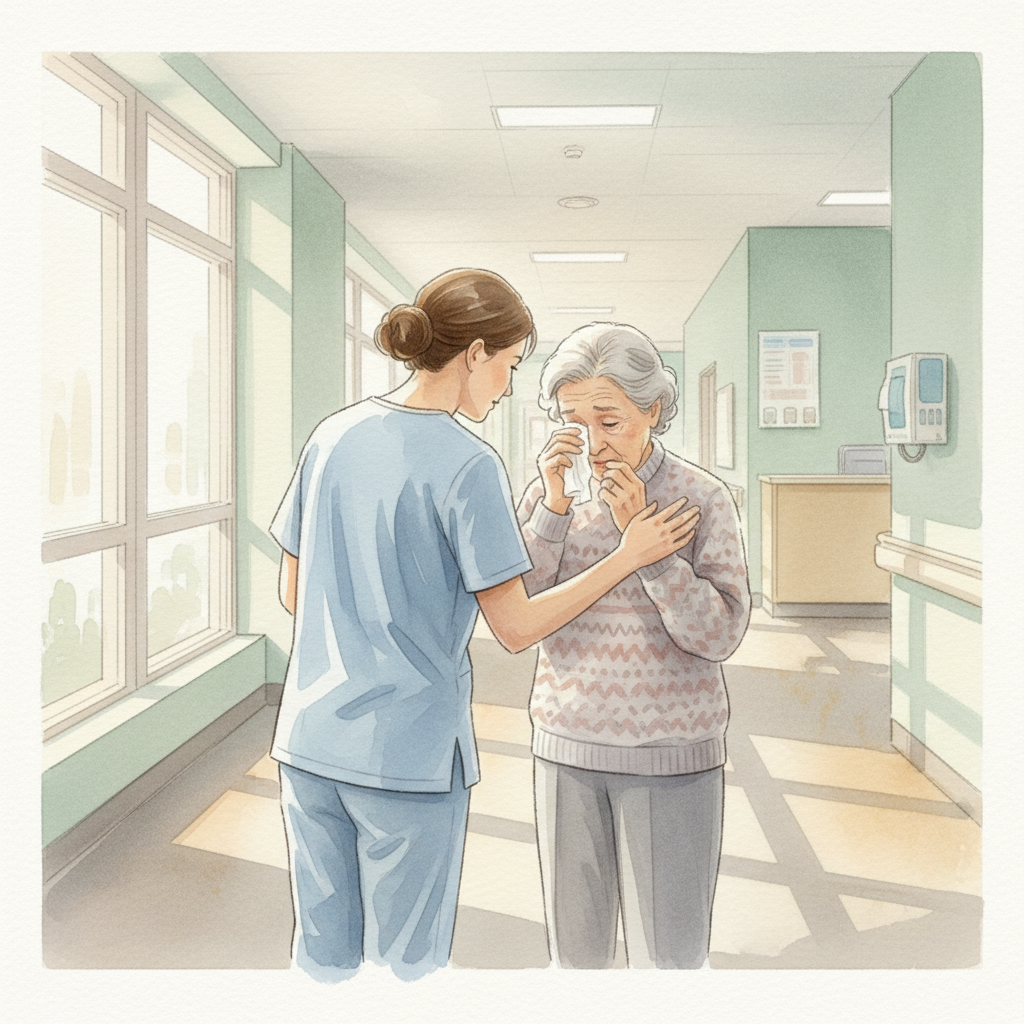
- Stay with them. Don't walk away mid-conversation. Even 30 seconds of presence matters.
That's the whole script. You can stretch it out or shorten it depending on how the family is responding, but those five beats cover 90% of these encounters.
What NOT to do
Don't make up a softer version of the answer they want. Don't say "she seems comfortable" in a way that implies she's getting better when she's not. Don't minimize ("everyone dies eventually") even though it's technically true. Don't share your own experience with your grandmother's death unless they ask, and even then, keep it brief. Don't cry with them in the hallway — you can be warm without breaking down, and if you do get emotional, that's okay, but it should redirect to a colleague taking over, not prolong the encounter.
The bigger picture
Families asking these questions are almost always asking because they already know the answer. They're looking for someone to confirm what their gut is telling them, and they're picking the most accessible person in the building to do that confirmation. Your job isn't to confirm — it's to walk them to the person who can. When you do that, you're not dodging. You're caring for the family in the only way that's actually allowed to you.
The original CNA in that post said she felt horrible. She shouldn't. She told the truth about her scope, she offered a next step, and she was honest about not knowing. That's the right answer. It doesn't feel like enough in the moment, but it is.
If this kind of post is useful, the full ExamReady library has 1,500+ practice questions, clinical skills with critical-step tracking, and an AI tutor that explains every answer — the same scope-and-voice approach as these posts, with the actual exam tools attached. A 7-day free trial gets you the whole thing, no card required.