 ExamReady CNA

Resident doesn't speak English: how to handle the barrier
A real r/cna question about a resident who nods yes to everything but clearly isn't understanding you. Why language barriers get mislabeled as confusion, and how to actually get through to him.
A CNA on r/cna posted this:
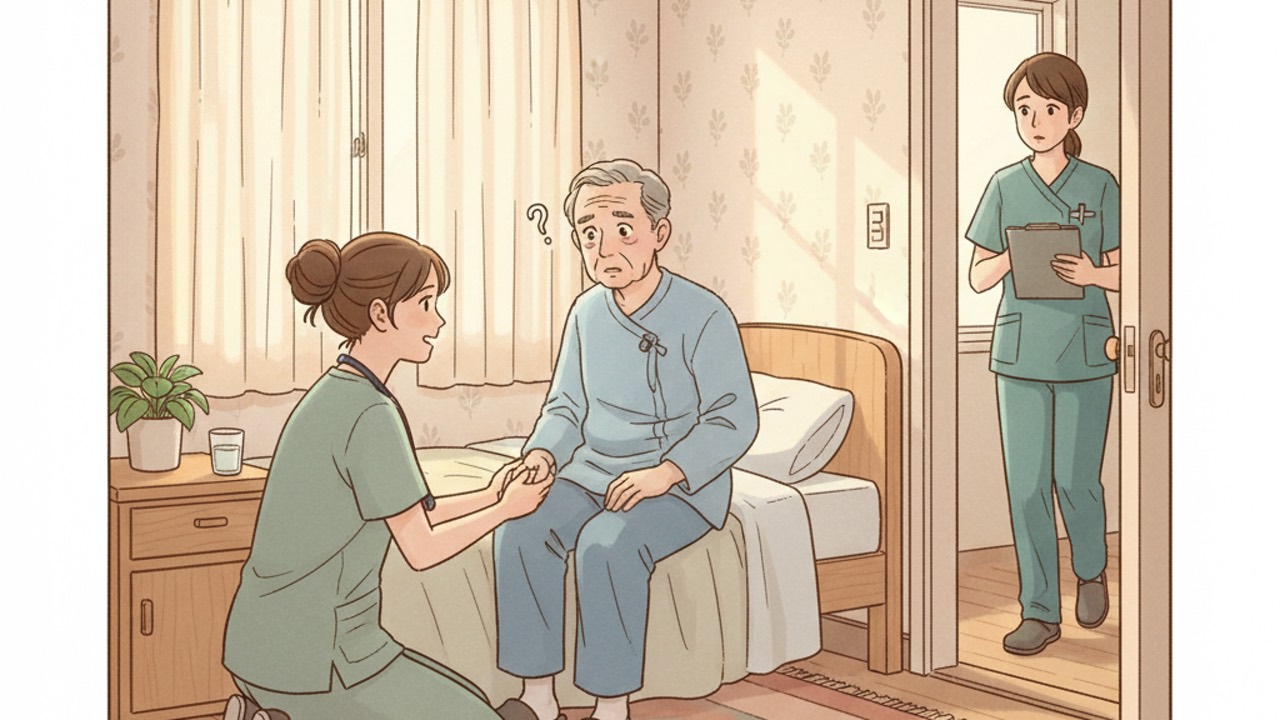
We have a new resident who only speaks a little bit of English. He nods and says "yes" to everything, but I don't think he understands a single thing I'm saying. Yesterday I told him to stay in his wheelchair and he got up and tried to walk across the room to the bathroom on his own. This morning the nurse said he was NPO for an appointment and I pointed at the tray and said "no food, sorry" and he ate all of it because he thought I was giving it to him. His daughter-in-law speaks English and comes in, but she's got three kids and she's rushing to work, so she's not really available. Some of the other CNAs on my shift just talk louder. The night shift keeps writing "confused" in the notes and honestly it's starting to make me doubt my own assessment. He's not confused. He's just speaking a different language than us. How do I do my job when I can't make sure he understands me?
This comes up constantly in SNFs and assisted living, and the damage starts the first shift. Here's the thing that's true almost every time: a resident who doesn't speak your language is not a confused resident. Two different problems, and they need two completely different responses.
The label that gets stuck on day one
The fastest way to end up with a resident who gets treated as cognitively impaired is to record "confused" the first time they don't answer you. Then every shift inherits that assumption, and the resident starts getting a care plan built for the wrong problem.
Watch what actually happens with "yes" and nodding. In a lot of languages, the word people use for "yes" is also the polite way to say "I hear you" or "okay." So when you ask a resident in broken English whether they understand the bed bath and they say "yes," you have learned almost nothing. Agreement is a social reflex, not proof of comprehension.
There's a second trap in this. The resident who nods along is easier to care for, so the shift drifts toward finishing the task and moving on instead of finding out whether the person understood the one instruction that actually mattered — the one about not standing up, or not eating, or pressing the call button when they need the bathroom.
Get a real interpreter, not a family member
This is the change that actually moves the needle. Ask your charge nurse for your facility's interpreter service or the language line. Most facilities have a process, even if nobody's used it in a while. Get the number, put it in your phone, and use it for anything that involves instructions, consent, or teaching.
Family is a reasonable option for the small talk, for reassurance, for family questions. It is a bad option for clinical instructions, for three specific reasons:
- Accuracy. A family member translating "don't stand up without calling" as "you can walk to the bathroom" is not malicious — they're nervous, they're summarizing, and they often don't know the clinical terms.
- Privacy. Some residents won't say or ask for things in front of their family. A resident who has a sore, who is embarrassed, who doesn't want to bother anyone — those things stay unspoken when the interpreter is a relative.
- Burden. The daughter-in-law with three kids and a job is not a staffing solution. Asking her to interpret clinical content puts her in a position she didn't agree to and can't really do well.
There's also a special caution about using children to interpret. Don't. It's not a resource, and it's a lot to put on a kid.
Teach back instead of asking if they understand
"Does he understand?" is a question with a useless answer. Ask him to show you instead.
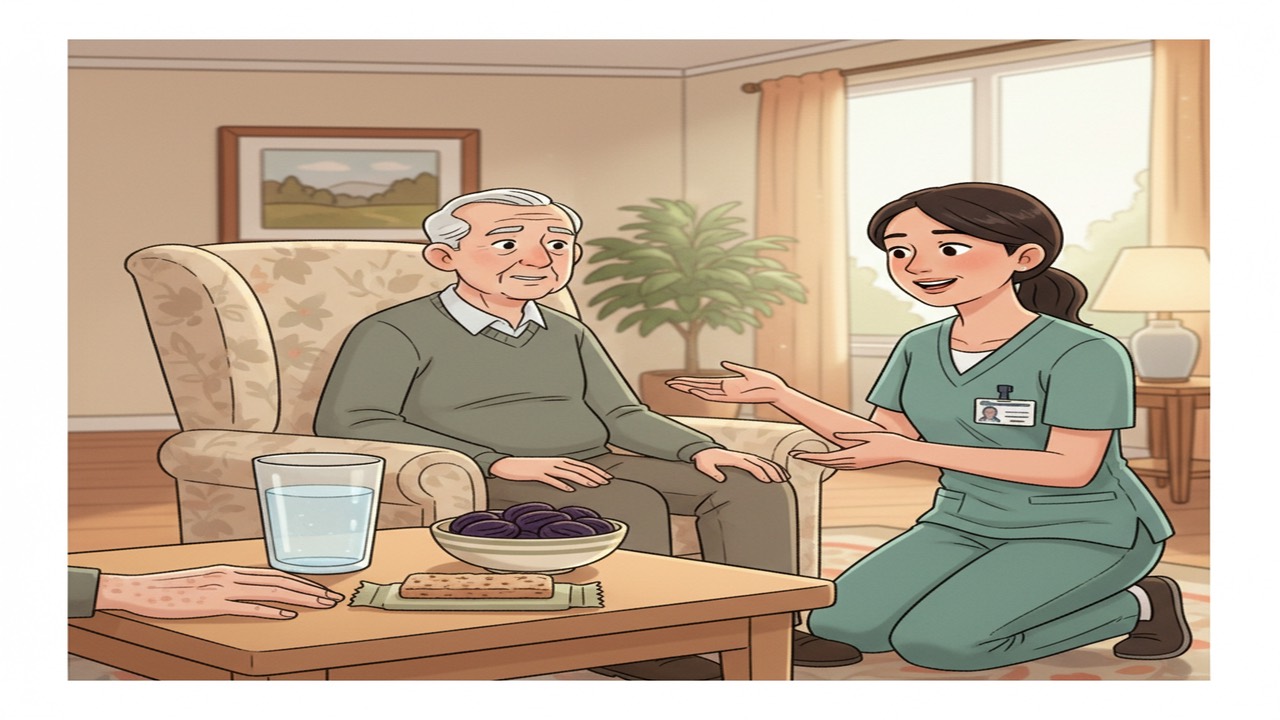
The teach-back method is simple: instead of giving an instruction and asking "got it?", give the instruction and then say "I want to make sure I explained that clearly — tell me what you're going to do." You're not quizzing him. You're checking your own explanation, and the phrasing keeps him from feeling tested.
For steps like transfers or walker use, demonstrate while you talk. Show the hand placement, show the sequence, then hand it over to him step by step rather than giving him the whole task at once. One step, then the next.
If he can read in his own language, a written checklist in that language helps more than you'd expect, especially for residents with hearing loss on top of the language barrier.
Tools that help on a normal shift
Picture cards. Laminate simple pictures for the routine stuff: call button, water, bathroom, no food, shoes off, pain here. This is the single highest-value thing you can do for a resident with limited English, because it removes the need for language entirely for the repetitive instructions.
Translation apps. Use them as a bridge, not as the source of truth. They are surprisingly good for short common phrases and unreliable for anything medical. Confirm anything important with a real interpreter or with teach-back.
Consistency. If you're the only one who uses the picture cards, that's not a system. Get two or three CNAs on the same set of words and gestures so he isn't relearning every shift.
Body language and tone. Slow down, face him, keep your hands visible, use gestures. The one that doesn't work is volume. Yelling at someone who doesn't speak your language doesn't add any information — it just makes the room tenser.
Document what you actually did
Write what you observed and what you did about it, not what you assume. "Resident did not appear to understand NPO instruction; used picture card and interpreter, verbalized instruction back to me" is useful documentation. "Resident is confused and non-compliant" is not — it hides the language barrier, misleads the next shift, and makes you look like the problem.
Also document the good news: when teach-back works, when the interpreter helped, when he finally understood the bed bath sequence. That's evidence for the care plan and for the family conversation.
What NOT to do
- Don't write "confused" or "oriented x3" because he didn't answer you. You have no data. Write what you saw and what you tried.
- Don't lean on a family member to explain clinical instructions, and don't use a child.
- Don't give up on comprehension because "yes" came back. "Yes" from a limited-English speaker usually means "I hear you." Verify.
- Don't skip a task or change the plan because communication is hard. If he didn't consent to the shower, that's a conversation with the nurse and the interpreter — not a decision to just do it faster anyway.
- Don't assume low English means low cognition. Some of your sharpest residents simply never learned your language.
The bigger picture
A resident who can't understand you can't advocate for himself, can't tell you his foot hurts, can't say he's cold, can't call for help reliably. That's a safety issue on top of a comfort issue, which is why the interpreter conversation belongs with the nurse and the DON instead of staying between you and the resident.
Your job is to build the bridge the best you can with what you have — picture cards, teach-back, consistent phrasing — and to report clearly when you need an interpreter. Do that consistently and you're doing your job well, even when the language gap is bigger than one shift can close.
If this kind of post is useful, the full ExamReady library has a deep bank of practice questions, clinical skills with critical-step tracking, and an AI tutor that explains every answer — the same scope-and-voice approach as these posts, with the actual exam tools attached. A 7-day free trial, then $9.99 per month, gets you the whole thing.
A little every day
Practice questions with kind explanations, and 23 clinical skills walkthroughs with critical steps flagged.
Start your 7-day free trial7 days free, then $9.99/month. Cancel anytime.