 ExamReady CNA
Is it delirium or dementia? How CNAs tell the difference
A real r/cna scenario about a normally oriented resident suddenly confused overnight — why sudden confusion is a change in condition, not a dementia stage, and what a CNA is supposed to do about it.
A CNA on r/cna posted this:
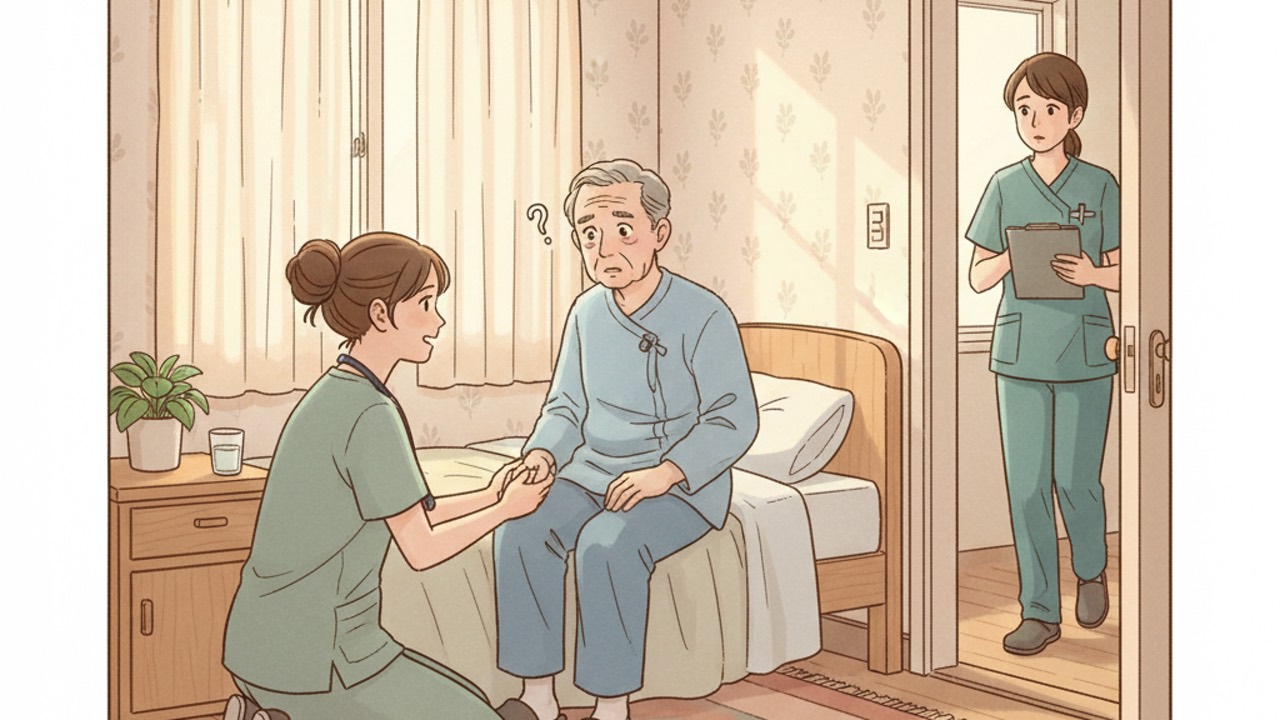
I need to vent and also get actual advice. We have a resident who has been totally fine for the last year and a half. Sweet old lady, knows every family member, knows the routine, never complains. Yesterday she was up at 4am asking me who I was and why I was in her house. Her son visited today and she asked him if he was the new paperboy. The nurse told me it's "just her dementia acting up," but she does not have a dementia diagnosis. She has been here two years and was totally oriented until this week. Now it is "just aging" and I should make her comfortable. Am I missing something?
The replies split fast. One side said report the change to the nurse. The other said a sharp CNA would have flagged it at 4am instead of waiting a full shift for a family member to notice. Both pointed at the same thing: something changed, and nobody wrote it down.
That's the whole post. This is not a dementia stage. This is a new symptom.
What delirium actually is
Delirium is an acute, fluctuating disturbance in attention and thinking. Acute means it comes on over hours to days. Fluctuating means the resident can seem perfectly clear in the morning and completely disoriented by lunch, then look fine again in the evening. Attention is the key word — not memory, not personality.
Dementia is chronic. It progresses over months and years, and it does not swing. A resident with dementia is confused steadily, in roughly the same way, day after day. If you saw her yesterday and today is a different animal, that is not dementia getting worse. That is something else.
This distinction is the most useful thing a CNA can carry onto a shift. You are the one person who sees the resident across the whole day. The nurse reads the chart. You see the change.
The differences, side by side
Onset. Dementia starts gradually, over years. Delirium starts abruptly — overnight, over one shift, or across a couple of days.
Course. Dementia is steady. Delirium comes and goes, so one shift tells you the resident is fine and the next shift tells you they are not.
Attention. This is the one to actually check. Say "I'm going to go get your breakfast, I'll be right back." Then come back and ask what you were going to do. A resident with dementia may forget. A resident with delirium often cannot follow the thread at all.
Fluctuation. Clear in the morning, agitated by dinner. Or the reverse. The pattern changing inside one day is a flag.
Level of alertness. A resident with delirium may be more agitated and restless than usual, or unusually sleepy and quiet. Dementia residents tend to stay at the same level.
Cause. Dementia has a cause that unfolds over years. Delirium almost always has a recent trigger.
The triggers you'll actually see in long-term care
A new or changed medication. The most common cause. A new med, a dose change, a med that got stopped, or several new meds at once. If the confusion started the day after a med change, that is your first call to the nurse, not a shift-handoff mention.
Infection. A urinary tract infection is the classic one in older adults, and it often shows up as confusion before fever or burning urination. Also pneumonia, skin wounds, cellulitis. New urinary urgency or new incontinence? Ask about infection.
Pain. Uncontrolled pain in someone with dementia often shows up as agitation, groaning, or refusal of care instead of "it hurts." New grimacing or new resistance during transfers — treat it as pain until proven otherwise.
Urinary retention and dehydration. A full bladder in an older adult can cause acute agitation and confusion, and new restlessness plus new urinary problems is a classic pair. Not enough fluid, or over-diuresis from new meds, hits the same way.
Sleep disruption and environment change. A resident who slept fine and is now up all day and all night. A new room, a new roommate, a hospital stay that just ended. Older adults confuse these badly.
Oxygen. Low saturation or anemia, anything that reduces oxygen to the brain. You check vitals — you might catch it.
What you do as a CNA
1. Run the quick screen. When you notice a change, check the basics: does the resident know where they are, who you are, can they follow a simple instruction, are they more agitated or more sleepy than usual, and do they have a new complaint — pain, urinary, no appetite?
2. Compare against what you know. What was she like yesterday? Two weeks ago? Write the difference down in plain words: "Named all four grandchildren this morning. Asked me where I came from three times in 20 minutes." Vague notes are useless. Specific notes change care.
3. Get vitals. If the resident looks unwell, take a full set within your scope — temperature, pulse, blood pressure, oxygen saturation, respirations. A new fever, fast heart rate, or low sat are findings the nurse needs now, not at end of shift.
4. Notify the nurse explicitly and get a response. Say the sentence out loud: "Mrs. Alvarez is new-confused since last night, she's oriented to person but not to place or time, and she has new urinary urgency." That tells the nurse this is a change, gives a time frame, and gives a symptom. If the response is "she's just dementia," that is still a response, and now it is documented. If there is no response at all, escalate to the charge nurse, then the DON.
5. Look for the fixable thing. A full glass of water offered. The bathroom. Ordered pain relief. A familiar blanket from home. Sometimes "behavioral change" is a resident who has sat in a chair for six hours needing to urinate.
6. Document everything, every time. Time of the change, what you observed, the exact words the resident used, who you told, and what they said back. Repeat entries are fine. Vague ones are not.
What NOT to do
Do not assume the resident has dementia because they are old and confused today. Age is not a diagnosis, and "she's just aging" is not an assessment. New confusion in someone who was oriented yesterday is a change in condition until proven otherwise.
Do not wait for the end of shift. The nurse is easier to reach at 7am than at 3pm, and if it is delirium, time matters — hypoxia, infection, and untreated pain get worse.
Do not just chart it and tell the next CNA. Charting without telling a nurse does not move the resident's care. If you reported it and nothing happened, escalate — charge nurse, then DON. Silence is not a safe place to leave a possible emergency.
Do not write "confused" and move on. "Confused" is not a finding. "Oriented to person, not to place or time, started around 4am, new urinary urgency at 7am, nurse notified 7:15am" is.
Do not quietly change the resident's care plan because you think you know what's going on. Report it and let the licensed team decide.
The bottom line
If a resident you know well is suddenly confused, the question is not "is this dementia?" The question is "what changed today?" Delirium is common, often fixable, and missed constantly because it gets filed under "dementia" or "just aging." You are most likely to catch it, because you saw her yesterday.
New confusion is a change in condition. Report it, document it concretely, and if nobody acts, escalate. That's the job.
For exam prep, /exam has practice questions on changes in condition, reporting, documentation, and scope of practice — the categories this scenario falls into.
If this kind of post is useful, ExamReady CNA has practice questions with kind explanations, clinical skills walkthroughs with critical steps flagged, and a study coach. Start your 7-day free trial. 7 days free, then $9.99/month. Cancel anytime.
A little every day
Practice questions with kind explanations, and 23 clinical skills walkthroughs with critical steps flagged.
Start your 7-day free trial7 days free, then $9.99/month. Cancel anytime.