C. diff isolation room: how CNAs handle contact precautions without panic
A real r/cna question about being assigned a resident with active C. difficile for the first time. What PPE to wear, how to handle the room, and how to keep everyone safe.
A CNA on r/cna posted this:
I just got my assignment and one of my residents is in contact isolation for C. diff. I've never had an isolation patient before and I'm honestly freaking out. The nurse handed me a gown and gloves and said "you know what to do" and walked away. I don't know what to do. Am I going to get sick? Am I going to spread it to my other residents? Do I wear the same gown into the room and out? Please help.
This post got 612 upvotes and 180 comments. C. diff is one of the most common infections in long-term care, and almost every CNA will be assigned an isolation resident at some point in their first year. Here's what you actually need to do.
What C. diff actually is
Clostridioides difficile (C. diff) is a bacterium that causes severe diarrhea, usually after a resident has been on antibiotics. The antibiotics kill off normal gut flora and C. diff takes over. It spreads through spores — tiny, hard-shelled bacteria that survive on surfaces for months. Bleach is what kills them. Alcohol-based hand sanitizer does not.
For you, this matters because you can carry the spores out of the room on your hands, your clothes, your pen. Standard precautions aren't enough. You need contact precautions on top.
The good news: contact precautions work. Facilities that follow them rigorously have dramatically lower C. diff transmission rates. The whole point of the protocol is that it works if you follow it.
What "contact precautions" means in practice
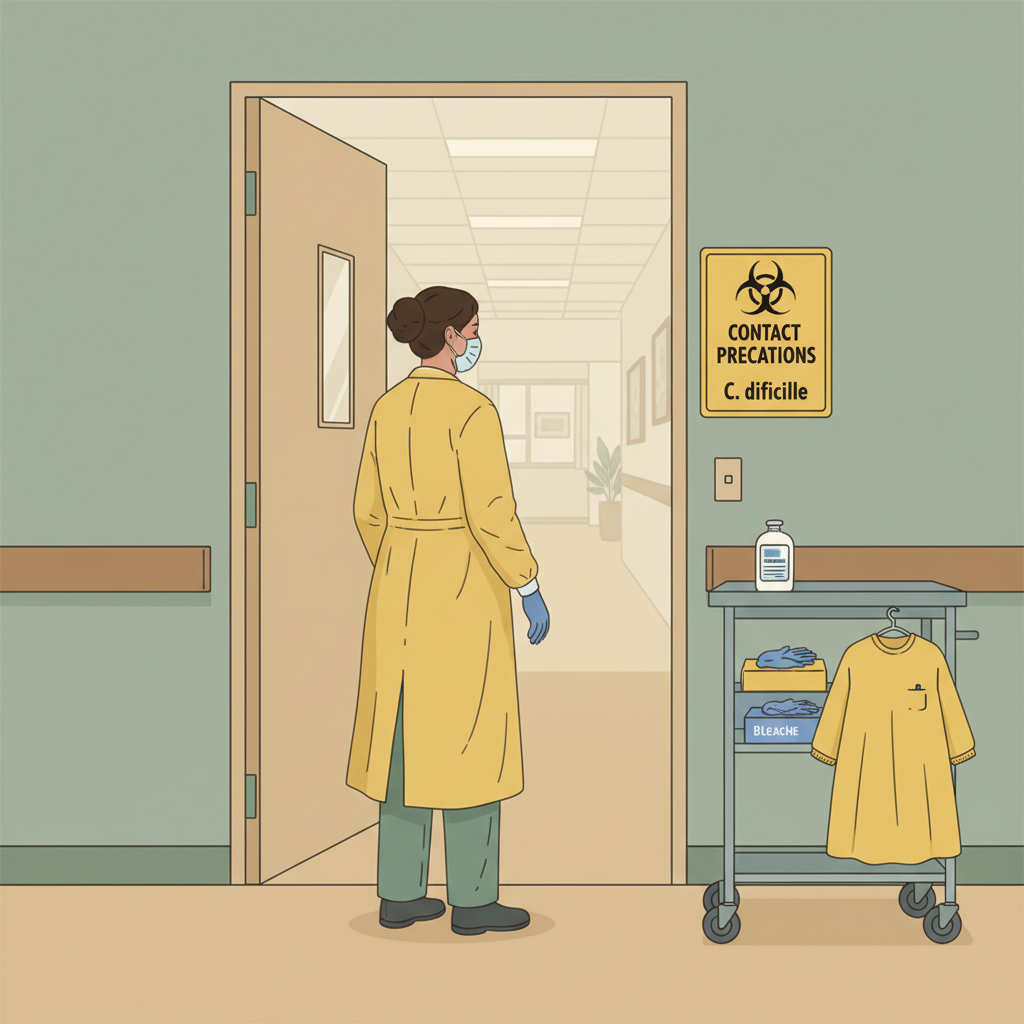
When you walk up to the door of an isolation room, you should see a sign on the door (usually yellow or orange), a cart or rack outside the room with gowns, masks, and gloves, a trash can inside, and a bottle of bleach-based disinfectant at the bedside.
Before you go in, you put on:
- Gown — ties at the back of your neck and waist. It goes over your uniform, neck to knees.
- Gloves — pulled over the cuffs of the gown so there's no skin exposed at the wrist.
- Mask — for C. diff specifically, your facility may or may not require a mask. Follow your facility's policy.
That's it for entry. You do not need a powered air respirator. You are wearing a gown and gloves. That's the protocol.
What to do inside the room
Treat the room as if everything is contaminated. The bed rail, the call light, the TV remote, the bathroom door handle — all of it can have spores on it.
- Bring only what you need into the room. Leave your pen, your phone, your assignment sheet on the cart outside.
- If you bring something in (a blood pressure cuff, a basin), it stays in the room until it's been wiped down with bleach.
- Wear the same gown and gloves for the whole visit. Don't change them between residents — there's only one resident in the room.
- If your gloves tear or you contaminate your hands mid-care (cleaning up stool, for example), doff and re-glove.
The single most common mistake new CNAs make in isolation rooms is touching clean things with dirty gloves. You glove up, you adjust your mask, you push your hair back, you grab the call light to silence it — all of those things are now contaminated. Either do them before you glove up, or do them knowing you'll be wiping them down.
How to doff (take off) PPE without contaminating yourself
This is the part that's actually hard. Most C. diff transmission to healthcare workers happens during doffing, not during care.
The sequence:
- Gloves off first. Pinch the outside of one glove at the wrist, peel it off inside-out, ball it up in the gloved hand. Slide a finger under the cuff of the second glove and peel that off inside-out too, encasing the first glove inside the second. Drop both into the trash.
- Gown off next. Unfasten the neck and waist ties. Pull the gown forward off your shoulders, touching only the outside (which is contaminated) and the inside of the gown (which is clean). Roll it inside-out into a bundle and drop it in the trash or the linen hamper — whichever your facility uses for gowns.
- Wash your hands with soap and water at the sink inside the room. Not sanitizer. Soap and water. C. diff spores are not killed by alcohol.
- Exit the room.
- Wash your hands again at the sink just outside the room.
The mental model is: outside of gloves and gown = dirty. Inside of gown = clean. Your bare skin = clean. Never let dirty touch clean.
If you're not sure whether you doffed right, watch a 90-second CDC video on it. Your facility's infection preventionist can also walk you through it on your first isolation assignment.
What about your other residents?
After you've doffed and washed, you are not a contamination risk. Your uniform is fine. Your hair is fine. Your stethoscope, if you didn't bring it into the room, is fine.
The biggest real risk to your other residents isn't you — it's the equipment. A shared blood pressure cuff has to be wiped with bleach before it goes back on the cart. A shared lift needs the sling and handles wiped. If you grabbed the wrong resident's water cup on your way out because you forgot which room you were in, you just contaminated that cup.
A simple rule: anything that physically enters the isolation room gets wiped down or stays in the room. Your phone stays on the cart. Your pen stays on the cart. The cuff stays in the room.
The honest part: how to handle the fear
It's normal to be scared of an isolation assignment your first time. Most CNAs are. A few things to keep in mind:
- C. diff is spread by oral-fecal route. As long as you wash your hands before eating and don't touch your face in the room, your personal risk is low.
- The resident in the room already has C. diff. Your job is to prevent spreading it to other residents — not to protect yourself from this particular resident (though good PPE does both).
- The isolation protocol is a feature, not a punishment. It means the care team identified the risk and put a system around it. That's the system working.
- You will get faster at donning and doffing. By your third isolation assignment, it will be routine.
If your facility is so short-staffed that you can't follow the protocol — they want you to do 12 residents including an isolation patient with no help — that's a staffing problem, not a you problem. Flag it to the charge nurse. Flag it to the infection preventionist. Flag it to the DON. You cannot safely run contact precautions on five residents simultaneously, and no facility should ask you to.
What NOT to do
- Don't wear the same gown between residents. One gown, one room, one resident, one entry. Take it off in the room.
- Don't skip the handwash because you used sanitizer. Alcohol does not kill C. diff. Soap and water only.
- Don't bring your phone or pen into the room. If you must, wipe it down with a bleach wipe before it leaves the room.
- Don't eat or drink in the isolation room. No water bottle at the bedside, no snack on your break in there.
- Don't tell the resident their C. diff is "dirty" or "gross." They're already embarrassed. They're isolated from friends and family. Treat the infection, not the person.
The full ExamReady library walks through every clinical skill with the same critical-step tracking — when a step actually matters for safety versus when it's just routine. The contact precautions module is one of the most-tested skills on the state exam. A 7-day free trial gets you the whole library, no card required.
If this kind of post is useful, the full ExamReady library has 1,500+ practice questions, clinical skills with critical-step tracking, and an AI tutor that explains every answer — the same scope-and-voice approach as these posts, with the actual exam tools attached. A 7-day free trial gets you the whole thing, no card required.