Coworker won't answer call lights: what to actually do
A real r/cna question about a coworker who hides from call lights while the rest of the team drowns. What the charge nurse should do, what you can do, and what to never do — even when you're furious.
A CNA on r/cna posted this:
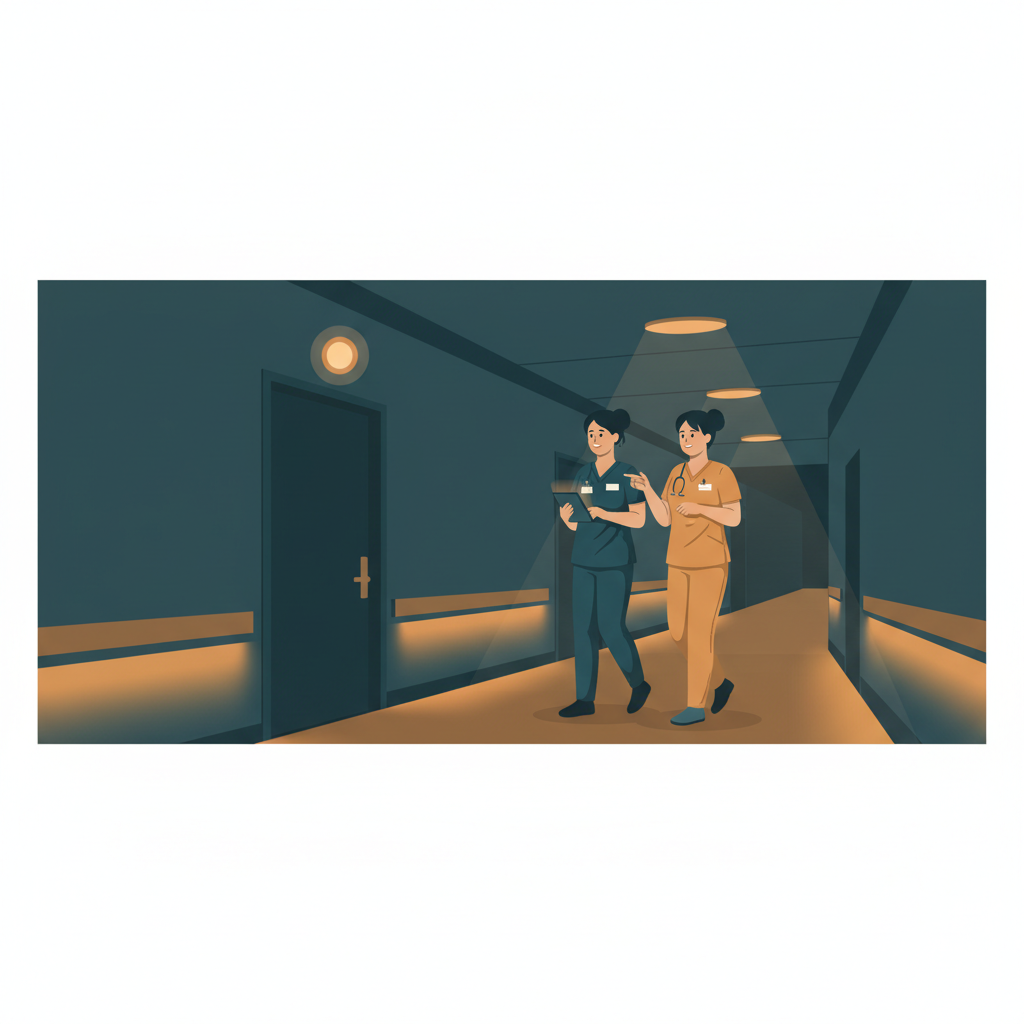
I work nights on a 30-bed unit and there's one CNA — let's call her D — who disappears. Like, the lights are going off, everyone else is running, and she's in the break room on her phone. We all see it. The other CNAs have started doing her side as well as our own because residents are waiting 20+ minutes for someone to come. The charge nurse either doesn't notice or doesn't care. I'm exhausted. I'm doing the work of two people and getting paid for one. What do I do?
This post got 412 upvotes and 174 comments. The split in the comments is the interesting part — half say "report her," half say "don't be a snitch, just pick up the slack." Both are wrong. Here's what's actually true.
What's really going on
Before you act, figure out which of these you're dealing with. They need different responses.
The new CNA who's drowning. She might not be hiding — she might be panicking. New grads and new hires sometimes freeze when they're behind. Going to the break room is avoidance, but it's avoidance born of overwhelm, not malice. Watch her for a few shifts before you conclude she's lazy.
The burned-out CNA who's checked out. CNAs who've been on a unit for years sometimes develop callousness. They've seen the staffing, the politics, the broken promises. They've stopped believing their effort matters. You can recognize this type by the thousand-yard stare and the immediate dismissal whenever you bring up workload.
The manipulator. Some CNAs learn exactly how little they can do before the charge nurse notices. They know which hallways get walked, which rooms get checked. They time their breaks so they look busy. This is rare but real.
The CNA with a personal crisis. Could be a sick kid, a death in the family, an eviction. Some people cope by going numb at work. Not your job to fix their life, but it changes how you frame the conversation.
Most situations are some combination of the first two. The third is rarer than people on Reddit assume.
What NOT to do
Do not confront her one-on-one in anger. "Hey, I saw you on your phone while I was answering Mrs. K's light" — that conversation, if it happens at all, will go badly. You'll either freeze up and apologize, or you'll explode and she will, too. Neither helps your residents.
Do not start a group chat about her. CNAs who get piled on by coworkers become defensive, not productive. The unit culture sours. The charge nurse hears about it and now it's a he-said-she-said situation you're both losing.
Do not do her assignment forever without telling anyone. You are training the unit — including the charge nurse — that her not-working is acceptable. You are also burning yourself out at a speed that will leave you either quitting or making a mistake that hurts a resident. The "just pick up the slack" advice is how people leave the field at 24.
Do not gossip to residents or families. "Oh, that CNA? Yeah, she doesn't really answer lights." That single sentence can get you disciplined and her fired and the resident more confused than they already were. Don't.
What actually works
Step 1: Talk to her directly, but gently, once.
A simple, non-accusatory check-in works more often than people think. "Hey, I've noticed the call lights on the west hall are piling up during your stretch. Is everything okay? Is there something I can help with?" Most people, confronted without aggression, will either explain or self-correct for at least a few days. If they blow you off — fine, you tried, now move to step 2.
Step 2: Bring it to the charge nurse — with specifics, not feelings.
"Vance nurse, I want to talk about call-light response times on the west hall between 11pm and 3am. I'm tracking about 20-minute average waits. I'm answering roughly 18 lights a shift on a hall I'm not assigned to. I want to figure out how we fix this as a team."
That's a different conversation than "D isn't doing her job." You're not making accusations. You're flagging a clinical problem — late call-light responses are a fall risk, a skin-breakdown risk, a survey deficiency — and asking the charge nurse to do their job. Document the conversation in your own notes (date, time, what was said) even if it's verbal.
If the charge nurse is the problem — they see it and don't care — then it's the DON's turn.
Step 3: If the charge nurse doesn't act, escalate.
DON, ADON, unit manager. Same framing: "Call-light response times on this unit are averaging 20+ minutes on certain shifts. I want to flag this because I'm worried about resident safety." You're not "telling on" anyone. You're reporting a quality-of-care issue.
Step 4: If the facility doesn't act, document and decide.
If nothing changes after a month of escalation, you have a problem that isn't going to get fixed. Your choices are: live with it (not recommended — you'll burn out or make a mistake), transfer units, or leave. CNAs who document properly and escalate through proper channels often find that one of those three paths opens up because facilities don't love having a paper trail of unresolved issues.
The paper trail
This is the part nobody on Reddit wants to do but everyone should.
Every time you answer a call light on a hall that isn't yours, write it down. Time, room number, what the resident needed. Keep it in a small notebook you take home. If a family member complains that "no one ever comes," your notebook is your defense. If a survey comes through and you want to flag the issue to the state, your notebook is evidence that isn't just your word against hers.
This is also how you protect yourself when she eventually blames you for something. People who don't work tend to blame others for the things that don't get done. Your notebook is your receipt.
What about the residents?
In the middle of all this, the residents are still there. They're the only reason any of us have a job.
If the call light is going off and your coworker isn't answering it, answer it. Yes, even when it's "her" resident. Yes, even when you're already behind. The resident doesn't care about the politics of your unit. They care that someone comes when they call.
Then go do step 1 above. The goal isn't to punish your coworker. The goal is to make sure that resident never waits 20 minutes again.
The hardest version
Sometimes you do everything right — the conversation, the charge nurse, the DON — and the facility still doesn't act. The understaffing is built into their budget. The CNA they don't replace is cheaper than the CNA they'd have to hire. You can't fix that from the floor.
That's when you decide whether this facility is one you can work at. Most CNAs who've been in the field more than five years have a short list of places they won't go back to. The list is usually built around exactly this problem.
You're not failing because your coworker won't pull her weight. You're failing only if you let the residents suffer while you fight the battle you were never going to win.
ExamReady CNA's /exam simulator includes scenarios on teamwork, delegation, and what to do when you witness a coworker cutting corners — the kind of ethical call that shows up on the real NNAAP written exam.
If this kind of post is useful, the full ExamReady library has 1,500+ practice questions, clinical skills with critical-step tracking, and an AI tutor that explains every answer — the same scope-and-voice approach as these posts, with the actual exam tools attached. A 7-day free trial gets you the whole thing, no card required.