Family member yelling at you about a resident's care: how to handle it
A real r/cna scenario about a son who cornered a CNA in the hallway and started yelling about his mom's care. What de-escalates the moment, what makes it worse, and what to document afterwards.
A CNA on r/cna posted this:
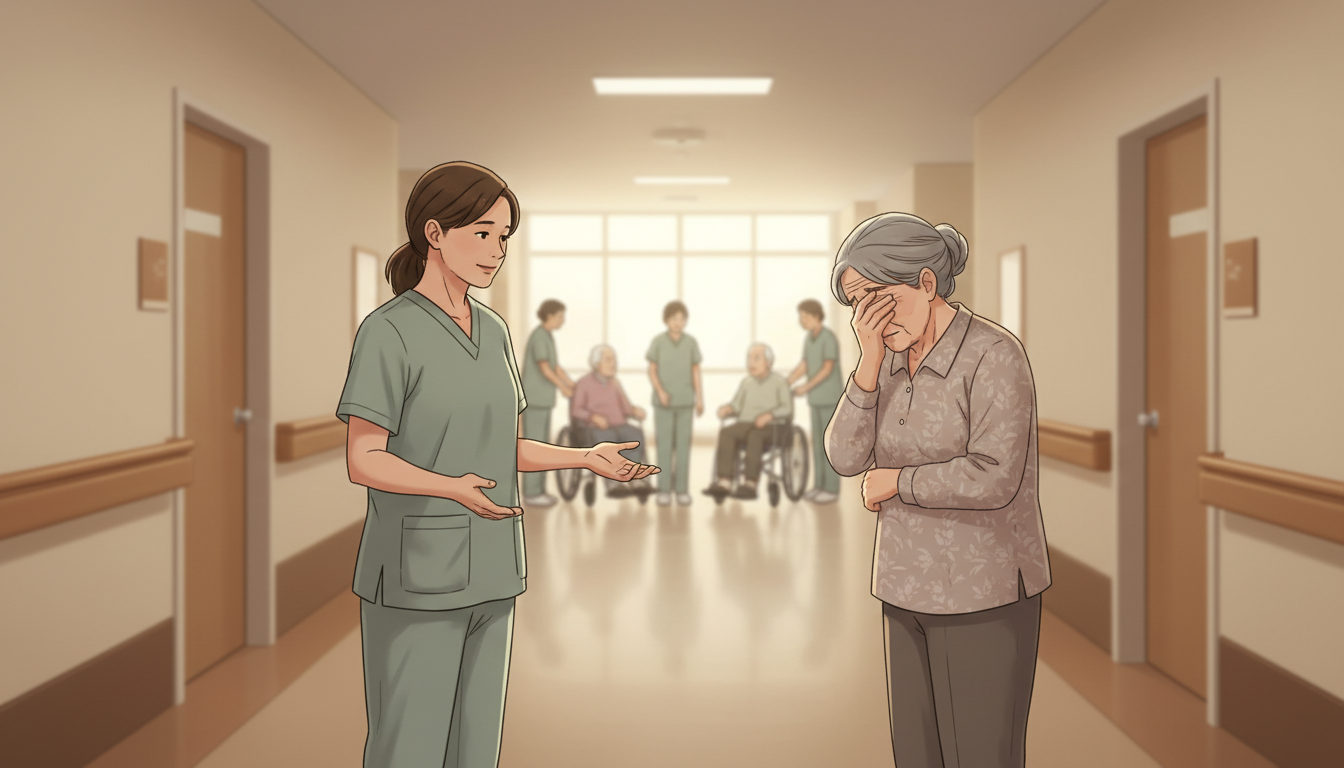
Yesterday a resident's son flagged me down in the hallway, asked me three questions about his mom in a row, and when I told him I'd have to ask the nurse he started yelling at me — in front of other residents, in front of staff — saying I clearly didn't know what I was doing and his mom deserved better. I just stood there. I didn't know what to say. I didn't want to cry in front of him. I didn't want to escalate. I went home and cried anyway.
This kind of thing happens in almost every facility. Here's what's going on underneath it, what tends to defuse it, and what to do after.
Why family members lash out at CNAs
You're not the actual problem. You're the accessible problem.
Most of the time, the son yelling at you in the hallway is carrying weeks or months of fear, guilt, and grief. His mom is in a SNF. He can't fix it. He visits when he can. He sees her declining. He has a thousand questions that nobody on the care team has answered clearly. He watches you walk past his mom's room for the eighth time in a shift because you're caring for nine other residents, and he reads it as neglect.
When that pressure finally cracks, it lands on whoever is standing closest. That's almost always the CNA, because you're the one in the room, in the hallway, at the bedside. Nurses float between rooms and the chart; CNAs are visible.
It's not personal. It feels personal because the yelling is happening to your face, but it's usually not about you as a person. It's about a system the family doesn't trust and can't control.
That said — understanding why doesn't make it acceptable. You're still a person, and being yelled at in front of residents is not part of your job description.
What to do in the moment
The instinct is to defend yourself. Don't. Defensiveness — "I'm doing my best," "We're short-staffed," "That's not my job" — is gasoline on the fire. Every sentence you add is a new sentence he can argue with.
What tends to work:
Move him out of public space. The hallway, the dining room, the lobby — these are the worst places for a confrontation. Other residents are watching. Staff are watching. He's performatively angry because there's an audience, even if he doesn't realize it.
Try: "I want to give you my full attention. Can we step into the conference room for a few minutes?" Or the family lounge. Or even just down the hallway away from other residents. Moving locations changes the dynamic more than any words you can say.
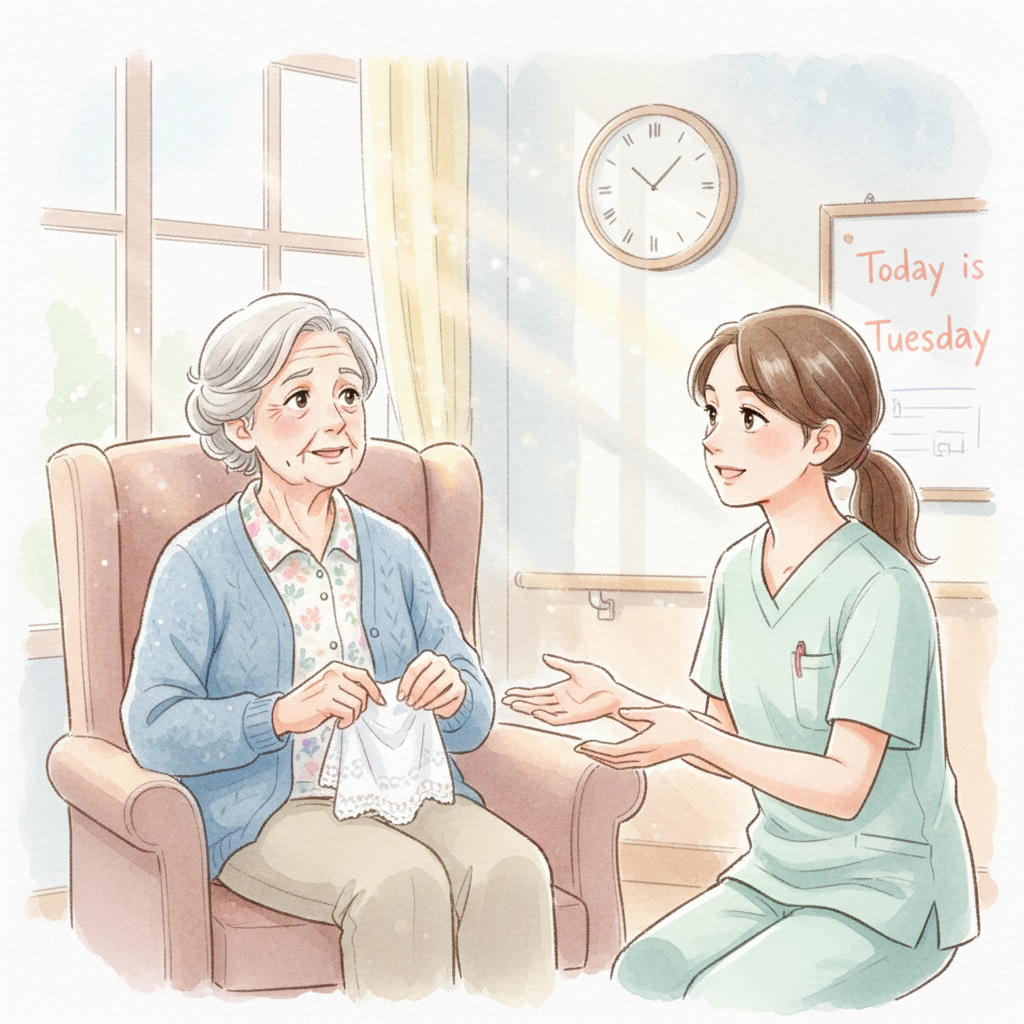
Acknowledge what he's feeling before you say anything else. Not apologize — you have nothing to apologize for — but acknowledge. "I can see you're really worried about your mom. That's understandable." Or "I hear that this is frustrating."
You're not agreeing with him. You're signaling that he has been heard. People who feel heard de-escalate. People who feel dismissed escalate.
Name what you can do, not what you can't. Don't say "I can't answer that." Say "That's a great question for the nurse on her unit — let me find her right now." Or "I can pull up the care plan with you." Or "Let me get the charge nurse so we can sit down together."
Specific actions beat vague promises. "I'll check on her in 30 minutes" is more calming than "We're taking good care of her."
Set a clear boundary if he doesn't stop. If he follows you, raises his voice louder, blocks your path, or starts making personal insults, you are allowed to end the conversation. "I'm going to step away now and bring my supervisor over. I'll be right back." Then actually go get the supervisor. You're not abandoning the resident — you're escalating to someone with more authority and a better position to handle it.
What NOT to do
A few patterns that look reasonable but almost always backfire:
- Don't apologize for things that aren't your fault. "I'm sorry we're understaffed" is not yours to apologize for. It also confirms his narrative that the facility is failing.
- Don't match his energy. Yelling back, rolling your eyes, sighing loudly, walking away mid-sentence — all of these will get written up in an incident report, not him.
- Don't promise things you can't deliver. "I'll make sure someone checks on her every hour" — if you can't guarantee that, don't say it. Broken promises are what fuel the next confrontation.
- Don't take it to social media. It happens. Don't do it. Even a private venting post in a closed group can find its way back to the facility.
- Don't ignore it. Sometimes CNAs try to power through and act like it didn't happen. That just lets the resentment settle in.
After the confrontation
Once the moment has passed and you're back at work or home:
Document it. Time, location, what was said (in your own words — you don't have to quote exactly), who else was present. Most facilities have an incident report form for family interactions. Use it.
This protects you in three ways. First, if the family escalates to the DON or to corporate, there's a record. Second, if the same family member does this to another CNA, your note gives the team a heads-up. Third, if the family later claims you were rude or unprofessional, your version of events is on file.
Talk to your charge nurse or supervisor. Not to tattle — to flag. The supervisor needs to know that this family is at a boiling point so the care team can have a proper conversation with them. Often the right move is a care plan meeting — family, nurse, DON, social worker — where the family actually gets their questions answered by someone with authority. Your hallway conversation wasn't that meeting, and it shouldn't have been.
Take care of yourself. Being yelled at is stressful in a way that lingers. It's normal to feel shaky, angry, or like crying after. Talk to a coworker who gets it. Eat something. Take your break if you haven't. If the same family keeps targeting you specifically, that's a workplace safety issue, not a personal-failure issue — escalate to your manager and, if needed, your union rep.
The bigger picture
Most family conflicts in long-term care are about information, not care quality. The son who yells in the hallway is almost always a son who hasn't been invited to a proper care plan meeting in months. Facilities that do regular family updates — even short ones — have dramatically fewer of these blowups.
When you can, gently push for that meeting. "I think it would help if you, the nurse, and the DON sat down together — would you like me to pass that along?" That one sentence often defuses the next encounter, because the family member feels like they now have a path that doesn't require screaming.
You can't prevent every confrontation. But you can walk into them knowing what they usually mean, what usually works, and what to do with the paperwork afterwards.
When a family member's behavior crosses from frustrated to abusive — threats, racial slurs, following you to your car — that's a workplace safety issue, not a communication challenge. Document it, report it, and know your facility's policy on restricted visitors.
For more on staying steady in high-pressure resident interactions, the clinical scenarios in /skills/dementia-resident-refuses-shower walk through similar de-escalation patterns.
If this kind of post is useful, the full ExamReady library has 1,500+ practice questions, clinical skills with critical-step tracking, and an AI tutor that explains every answer — the same scope-and-voice approach as these posts, with the actual exam tools attached. A 7-day free trial gets you the whole thing, no card required.