How long does it actually take to study for the CNA exam?
If you have 4 weeks, here's a realistic study plan. If you have 2 weeks, here's a tighter one. The honest answer is that most people study too long.
The most common question we hear: "how long does it take to study for the CNA exam?"
The honest answer is uncomfortable: most people study way longer than they need to. They spend 3 months going through a textbook and still don't feel ready. The material isn't that hard. The problem is approach.
Here's what actually works.
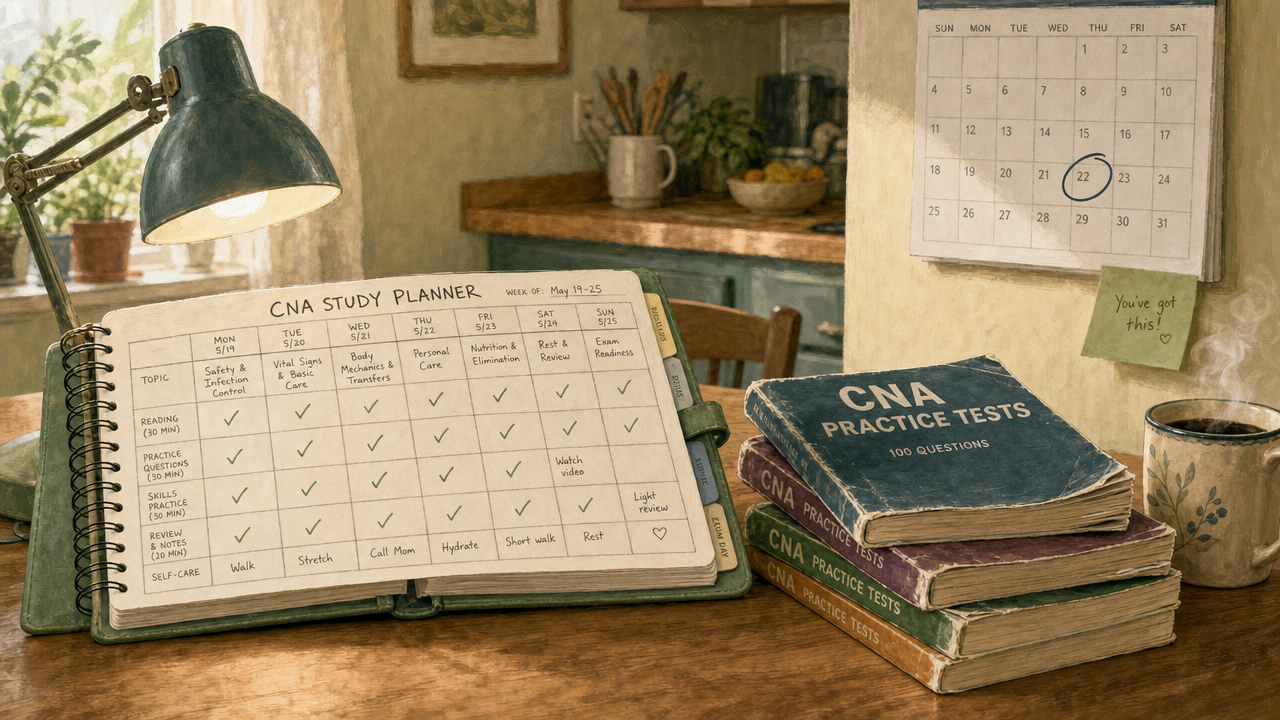
The 4-week plan (best case)
If you have a full month before your exam:
- Week 1: Read through the full scope of practice once. Don't try to memorize anything. Just get a feel for what's tested.
- Week 2: Start practice questions, 30–50 per day. Read the explanations on every wrong answer.
- Week 3: Identify your 2–3 weakest domains from the practice data. Drill those specifically.
- Week 4: Light review only. Take 2–3 full-length practice tests. Stop studying the day before the exam.
Total time: ~80–100 hours of focused study. That's about 3 hours per day for a month.
The 2-week plan
If you're short on time:
- Days 1–3: Skim the official NNAAP blueprint. Know what's tested and the weight of each section.
- Days 4–10: Practice questions, 50–80 per day. Use the explanations on wrong answers to fill gaps.
- Days 11–13: Drill the weak domains you identified during the practice week.
- Day 14: Mock exam in the morning. Review only your wrong answers in the afternoon.
Total time: ~50 hours. This is tight but workable if you already work in healthcare.
Why most people over-study
Three reasons:
- Reading feels like studying. Reading a textbook feels productive. It isn't. Reading without practicing is just entertainment. You'll retain maybe 10% of what you read.
- The comfort of passive learning. Doing practice questions is uncomfortable — you're wrong a lot. Reading is comfortable. People gravitate to what's easy.
- No signal to stop. When do you know you're ready? There's no "ding, you're ready" moment. Without practice test scores, people just keep going.
The fix for #3 is the most important. You are ready when your timed practice test scores are consistently 75% or higher on a full-length test. Not "I feel ready." Not "I read everything." Scores. Set that bar and stop when you hit it.
The trap of cramming
Cramming for the written exam doesn't work. The written exam tests application and judgment, which require weeks of practice to build. The clinical skills test is even worse for cramming — those are physical skills that need muscle memory.
If you're 2 weeks out and you've barely started, you're better off:
- Taking the practice test now to see where you stand
- Accepting that you'll probably need to push your exam date back
- Doing a focused 4-week plan rather than a panicked 2-week cram
What to skip on a tight schedule
If time is the constraint, drop these:
- Memorizing long lists. Mnemonics are great but only if you've already learned the underlying material.
- Reading every chapter of a textbook. Read the high-yield sections. Skip the historical context, the legal sections, the chapters on specialized populations.
- Practice tests before you've studied. A practice test taken with no prep just depresses you. Take your first one after a week of study, when the questions have something to attach to.
Where ExamReady helps with this
The app is built around the practice-first loop. You don't read a chapter and then take a test — you take a test, see what you missed, and the app points you at the exact concept. That's what cuts the 3-month study down to 4 weeks.
If you only have 2 weeks, use the timer. Practice questions under timed conditions, immediately. The exam is 90 minutes for the written portion. Time yourself. The first time you do it, you'll run out of time. The fourth time, you'll finish. That's the loop.
If this kind of post is useful, the full ExamReady library has 1,500+ practice questions, clinical skills with critical-step tracking, and an AI tutor that explains every answer — the same scope-and-voice approach as these posts, with the actual exam tools attached. A 7-day free trial gets you the whole thing, no card required.