 ExamReady CNA
Needle stick as a CNA: what to do in the first five minutes
A real r/cna question about sticking herself with an insulin syringe she was disposing of. The steps you take in the first five minutes matter for your health and for whether workers' comp covers you.
A CNA on r/cna posted this:
I was disposing of an insulin syringe after my resident's glucose check and the safety didn't engage. I was trying to get it into the sharps container one-handed because my other hand was holding the resident's gauze, and it slipped and stuck me in the finger. It wasn't deep but it bled a little. I washed it with soap and water for like a minute and put a bandage on and went back to work because I didn't want to make a big deal out of it. Now it's been four hours and I'm freaking out. What should I have done? Am I in trouble?
This is one of the most common sharps injuries in long-term care, and the answer is: she did the first step right and then stopped too early. Here's what should happen in the first five minutes, what to do after, and why skipping the reporting step can cost her far more than she's worried about right now.
What counts as a sharps injury
A sharps injury is any break in the skin caused by a needle, lancet, scalpel, broken glass, or any other object that could be contaminated with blood or body fluid. Insulin syringes, fingerstick lancets, suture needles, and broken medication ampules are the most common sources for CNAs. The injury doesn't have to be deep. A scratch that barely bleeds still counts.
If blood or OPIM (other potentially infectious materials) had a clear path into your body — through non-intact skin, your eyes, your nose, your mouth — that's also considered an exposure event and gets the same response.
The first five minutes — do these in order
The order matters. Don't skip ahead because you feel embarrassed or you don't want to "make a big deal."
1. Stop what you're doing and stay calm.
You have time. Most bloodborne pathogens don't transmit from a single superficial stick. The thing that hurts you in this situation isn't the stick — it's the next 24 hours of panic, or the infection you could have prevented if you'd reported it.
2. Wash the wound with soap and running water.
Not alcohol. Not bleach. Not hydrogen peroxide pressed into the wound. Just soap and running water for several minutes. The goal is mechanical flushing, not disinfection of the tissue. Alcohol and peroxide damage the tissue at the wound site and don't help.
If blood or fluid splashed into your eyes, nose, or mouth, flush those areas with clean water or saline for several minutes as well.
3. Don't squeeze the wound.
The old advice was to "milk" the wound to express any contaminated material. This is no longer recommended — it can damage tissue and push fluid the wrong direction. Just wash and let it bleed normally.
4. Get to a sink or eyewash station, but do not leave the floor silently.
This is the step most CNAs skip. You need to tell someone — the nurse on your cart, the charge nurse, whoever is supervising. The reason is below.
5. Report it. Immediately.
Tell your nurse. Tell your supervisor. Tell the infection control or employee health contact. This is the step the r/cna poster skipped, and it's the step that protects her legally and medically.
Why reporting matters even if "it was just a lancet"
Three reasons.
Reason one: post-exposure prophylaxis has a window.
For some exposures — particularly hepatitis B and HIV — there are medications that can dramatically reduce your chance of infection, but they work best when started within hours, not days. If you wait until your next shift to mention it, you may have missed the window. The nurse or employee health nurse needs to assess the source patient's status, your vaccination history, and your risk level, and start medication if indicated.
Reason two: workers' comp only covers what gets reported.
If you develop hepatitis C or anything else six months from now and your medical bills start piling up, workers' comp won't cover treatment for an injury you never reported. The legal threshold in most states is "report it the same shift," not "report it when you have time." The r/cna poster waited four hours; she's still inside the same-shift window if she reports now, but she shouldn't wait another hour.
Reason three: the source patient has to be tested.
The medical decision about what prophylaxis you need depends on knowing the source patient's infection status. That requires a blood draw on the source patient, which requires a provider order, which requires a report. You can't get this back later.
What the facility is supposed to do after you report
Once you tell your nurse, the facility has a documented process. In a well-run facility it looks roughly like this:
- An incident report is started within the shift
- The source patient is identified and, with appropriate consent, tested for HIV, hepatitis B, and hepatitis C
- Your blood is drawn for baseline testing
- The wound is assessed and documented
- If the source patient has a positive result, you're referred for post-exposure prophylaxis, usually within 1-2 hours of the result
- The incident is logged in the facility's OSHA sharps injury log
If your facility doesn't have a process, or shrugs it off, or tells you to "just put a bandage on it," that's a problem. Document the conversation, follow up in writing, and if needed, contact your state Department of Public Health or OSHA. You are not being dramatic. The process exists because the risk is real.
What to document yourself
Even though the facility is supposed to document, you should write down for yourself, that day:
- Time and location of the stick
- What you were doing (procedure, disposal, recapping — never recap, by the way)
- Type of device (insulin syringe, lancet, etc.)
- Whether the safety mechanism worked
- Your immediate first aid
- Who you told and when
- The source patient's room number (not name)
This protects you if the facility's incident report disappears, which happens more than people think.
What NOT to do
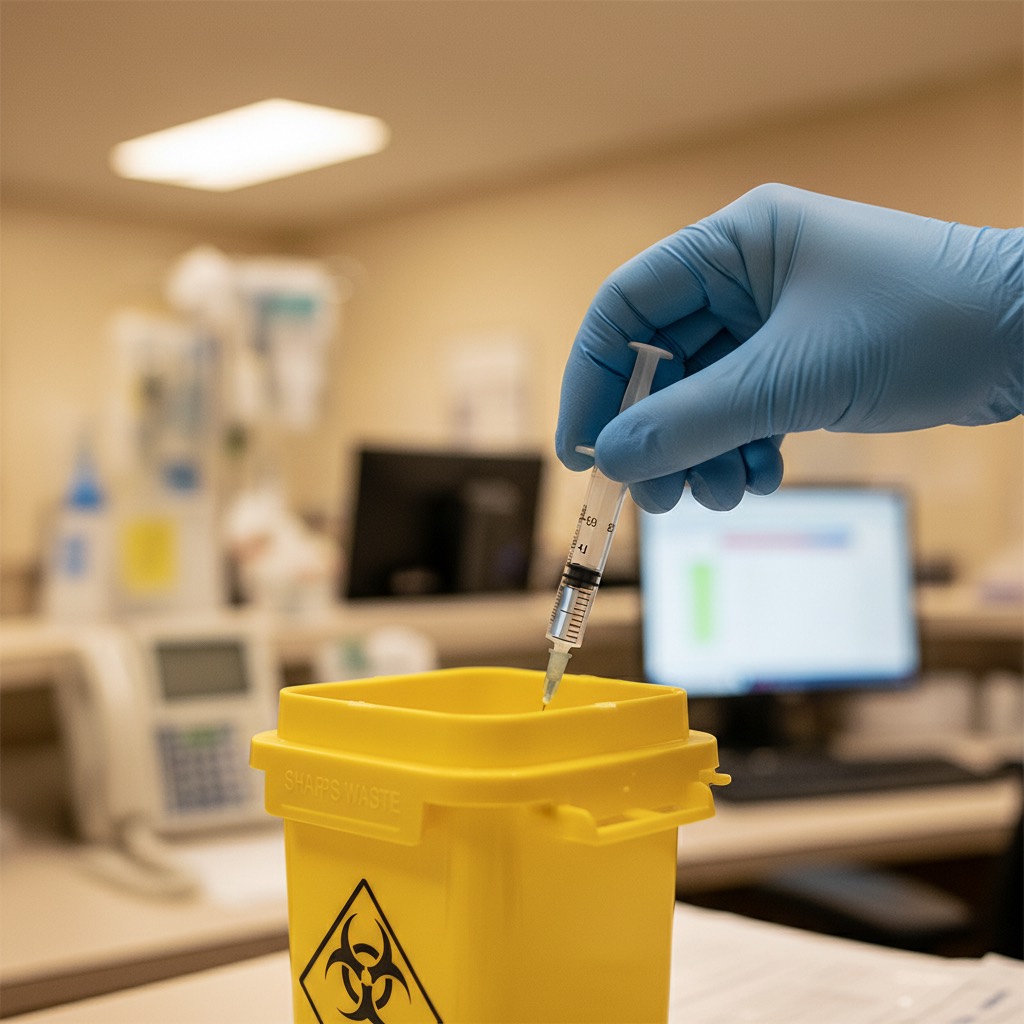
Don't recap the needle. If a needle didn't have a safety mechanism, or the safety failed, don't try to put the cap back on. Most sticks happen during recapping. Get it straight into the sharps container, two-handed if you have to.
Don't keep working through it. The r/cna poster went back to her assignment. She didn't have a choice — facilities pressure CNAs to finish the assignment — but the right move is to step away for the immediate first aid and the report. A coworker can cover your residents for 10 minutes. Your long-term health is worth more than a slightly behind schedule.
Don't scrub the wound with alcohol or bleach. This damages tissue and doesn't reduce transmission risk.
Don't squeeze the wound. Old habit, not recommended anymore.
Don't assume the resident is "low risk." You don't know someone's HIV or hepatitis status by looking at them. Half of people with chronic hepatitis C don't know they have it. Reporting is for situations where you don't know.
Don't skip step 4. If you get a sharps injury and your charge nurse tells you to "just write it up later," that's a red flag. The OSHA standard requires same-shift evaluation. Most states have the same rule. The charge nurse may be panicking about paperwork, not your health — but your health has to come first.
The good news
Needle sticks from insulin syringes and lancets in long-term care have a low transmission rate for most bloodborne pathogens, especially if the source patient is low-risk and you're vaccinated for hepatitis B (which you should be as a CNA — it's required by most employers and offered on hire).
The risk isn't zero. The risk is also not controllable by you after the stick happens. What you can control is whether the medical response moves fast enough to help you if the worst-case scenario turns out to be true.
Report it. Get tested. Take the prophylaxis if it's offered. Sleep tonight.
If this kind of post is useful, ExamReady CNA has practice questions with kind explanations, clinical skills walkthroughs with critical steps flagged, and a study coach. Start your 7-day free trial. 7 days free, then $9.99/month. Cancel anytime.
A little every day
Practice questions with kind explanations, and 23 clinical skills walkthroughs with critical steps flagged.
Start your 7-day free trial7 days free, then $9.99/month. Cancel anytime.